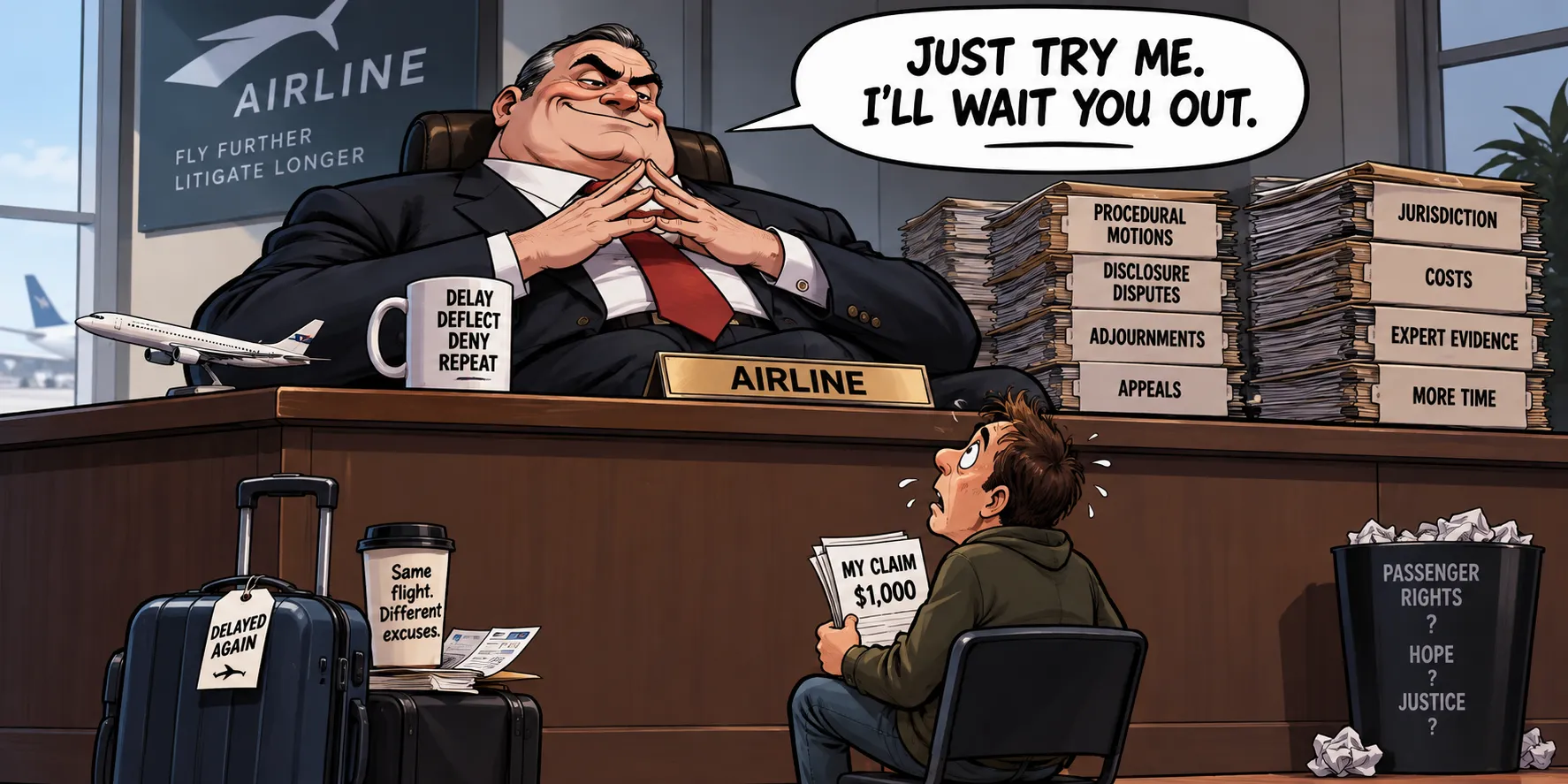
When the Process Becomes the Defence
Air passenger rights mean little if enforcing them costs more in time, money, and effort than the claim is worth. This article examines how delay, complexity, information asymmetry, and procedural attrition can shape APPR disputes long before a decision is reached.
The Air Passenger Protection Regulations are often discussed as though the central question is whether a passenger is legally entitled to compensation. In practice, that is only part of the problem.
For many passengers, the more important question is whether the right can be enforced efficiently enough to matter.
That distinction is critical. A regulatory regime can create clear statutory entitlements while still producing weak practical enforcement if passengers must navigate complicated claims processes, obtain information held by the carrier, decipher operational explanations, respond to changing legal positions, and remain engaged through lengthy proceedings over relatively modest amounts of money.
In that environment, procedure can become more than the mechanism used to resolve the dispute.
It can become part of the defence.
The economics of a $1,000 claim
The APPR creates standardized compensation for certain delays and cancellations. For a large carrier, compensation can reach $1,000 where the passenger arrives nine hours or more late and the statutory conditions are satisfied.
That sounds significant, and to an individual passenger it may be. But the amount is still small in litigation terms.
A passenger cannot rationally spend $5,000, $10,000, or more determining whether a $1,000 entitlement exists. Even where the passenger is self-represented, the non-financial costs can be considerable: time away from work, repeated correspondence, preparation of evidence, procedural research, hearings, uncertainty, and the frustration of dealing with an opponent possessing far greater institutional knowledge.
The carrier, by contrast, may defend hundreds or thousands of similar claims. It can develop standardized arguments, retain experienced counsel, create internal procedures, rely on existing databases, and spread the cost of legal strategy across an enormous volume of disputes.
The nominal value of the claim is therefore misleading.
The real contest is often between a one-time claimant seeking $1,000 and a repeat institutional litigant operating a national claims and legal system.
The information imbalance
Air passenger claims also contain an unusually important informational asymmetry.
The passenger generally knows what happened from the passenger's perspective. They know when the flight was scheduled to depart, when it was delayed or cancelled, what they were told, whether they received meals or accommodation, how they were rebooked, and when they eventually arrived.
But the carrier often holds the evidence needed to explain why the disruption occurred.
That information may include crew scheduling records, aircraft rotations, maintenance records, internal disruption codes, operational logs, communications between departments, airport restrictions, weather assessments, earlier flight disruptions, and the history of the particular aircraft or crew involved.
This matters because APPR entitlement often turns on classification.
Was the disruption within the carrier's control?
Was it within the carrier's control but required for safety?
Was it outside the carrier's control?
A passenger may be required to challenge the airline's classification without having access to the underlying operational information that produced it.
That creates a difficult structural problem: the claimant may need the litigation process to discover whether the claim was valid in the first place.
"Operational reasons" are not evidence
Passengers frequently receive short explanations for disruptions. Terms such as "adverse weather," "crew constraints," "operational reasons," "safety," or "unexpected maintenance" may be communicated during the disruption or later in response to a compensation claim.
Those explanations can be accurate. They can also be incomplete.
The problem is not simply that a passenger disagrees with the airline. The problem is that the legal consequences of the explanation can depend on factual details that are invisible to the passenger.
Consider a cancellation attributed to "crew constraints." That label alone does not necessarily establish the legal category of the disruption. The relevant questions may include why the crew was unavailable, whether the shortage resulted from events within the carrier's control, whether earlier disruptions caused the shortage, what contingency measures were available, and whether the carrier took all reasonable steps required by the applicable legal framework.
The passenger is unlikely to know any of this.
If the carrier's initial label effectively becomes the starting point of the dispute, the passenger may be placed in the position of trying to disprove an explanation based on records held exclusively by the opposing party.
The burden of persistence begins before any hearing takes place.
The claim itself is already a hurdle
The APPR does not generally require airlines to proactively pay delay or cancellation compensation merely because the carrier possesses all of the facts necessary to determine entitlement.
The passenger must make a claim.
That means the system depends, in part, on passenger knowledge and persistence. The traveller must know that compensation exists, understand that a claim must be made, submit it within the required period, provide the necessary information, interpret the airline's response (if any), calendar the response deadline, and decide whether to challenge a refusal.
Some passengers will do that.
Many will not.
This produces an attrition effect before formal litigation even begins. Every passenger who does not know about the entitlement, misunderstands the rules, gives up after a denial, misses a deadline, or decides the process is not worth the effort represents a claim that will never be tested on its merits.
The system therefore contains a natural form of breakage.
Where the regulated entity benefits financially from non-claiming, there is an obvious policy question about whether the burden of initiating payment has been placed on the right party.
The denial letter changes the psychology of the claim
The next stage can be equally important.
A passenger submits a claim and receives a response from the airline stating that compensation is not payable because the disruption was outside the carrier's control or was required for safety.
For many consumers, that is the end of the matter.
The airline is a sophisticated institution. Its response appears authoritative. The passenger may reasonably assume that the airline has applied the law correctly, even where the response contains little factual explanation.
A claimant who wishes to continue must now move from consumer to litigant.
That transition is significant.
They must decide whether to commence a proceeding in a provincial court or tribunal where jurisdiction permits, seek legal advice, or abandon the claim.
Each additional step filters out more claimants.
Attrition is therefore not necessarily a matter of aggressive courtroom conduct. It can arise from the architecture of the enforcement system itself.
Often, airlines don't even send a response to the claim. Now the claimant has to remember the 30-day deadline and calendar accordingly.
Repeat players hold the institutional memory
Airlines are repeat litigants.
Passengers are usually not.
That distinction is especially important in APPR disputes because the same legal issues recur continuously. Carriers develop positions on labour disruptions, crew shortages, cascading delays, maintenance issues, weather events, airport restrictions, safety classifications, rebooking obligations, causation, and evidentiary burdens.
The passenger may be encountering the issue for the first time.
An airline can learn from hundreds of prior claims. It knows which arguments have succeeded, which records decision-makers have required, which procedural objections are available, and how particular forums have approached recurring questions.
An individual passenger generally does not.
Where decisions are difficult to locate, unpublished, heavily redacted, or resolved through processes that produce little public jurisprudence, the informational advantage grows.
The carrier retains institutional knowledge.
The next passenger starts again.
Procedure can become disproportionately valuable
In high-value commercial litigation, extensive procedure may be economically proportionate. Discovery, expert evidence, lengthy hearings, interlocutory applications, and appeals can be justified where millions of dollars or complex legal rights are at stake.
That logic does not translate comfortably to a $1,000 passenger claim.
A procedural step that adds $2,000 of cost to a multimillion-dollar action may be insignificant. The same procedural step can destroy the economics of an APPR claim completely.
That is why proportionality is not an abstract procedural principle in this area.
It is central to whether the statutory right is real.
If a carrier can legitimately require a passenger to overcome procedural complexity whose cost exceeds the value of the claim, the carrier may prevail without ever persuading a decision-maker that its underlying position was correct.
The claim dies because the process became irrational to pursue.
Settlement is not always a measure of the merits
APPR disputes can also settle for reasons having little to do with legal strength.
A passenger may accept a reduced amount because the hearing is months away, because they are tired of dealing with the dispute, because they do not want to take another day off work, or because they are worried about costs.
From the outside, the file simply records that the parties reached a settlement.
That can obscure the effect of attrition.
Settlement is often an efficient and sensible outcome. But when one party's bargaining position is materially improved by its greater ability to absorb delay and expense, the settlement figure may reflect endurance as much as legal merit.
The same dynamic can operate in reverse. A carrier may choose to settle a claim that it believes it could successfully defend because the administrative cost of continuing exceeds the amount demanded.
That is ordinary litigation economics.
The concern arises when those economics systematically favour the repeat player because the claimant's right is too small to support meaningful enforcement.
Appeals and precedent can magnify the imbalance
For an institutional defendant, one case can matter far beyond the amount claimed.
A carrier may have a strong reason to defend a $1,000 case aggressively if the legal issue could affect thousands of future claims.
The passenger does not generally have the same portfolio interest.
From the passenger's perspective, the case may still be worth $1,000.
From the airline's perspective, the legal issue may be worth millions.
This creates an important mismatch in litigation incentives.
An airline can rationally spend far more than the individual claim is worth to obtain favourable precedent, preserve a legal interpretation, or discourage similar claims. The passenger, by contrast, bears the cost of litigating what may effectively become an industry-wide test case.
This is one of the most important ways in which the economics of APPR litigation can diverge from the apparent value of the dispute.
Delay has a different meaning for passengers
Time also operates asymmetrically.
A national carrier can maintain a litigation file for years. The dispute is one matter among many.
For the passenger, the same delay may mean repeated disruption of ordinary life.
Documents must be retained. Dates must be remembered. Evidence must be organized. Deadlines must be monitored. Hearings must be prepared for. A dispute arising from a single cancelled flight can remain active long after the trip itself has faded into memory.
The longer the process continues, the greater the likelihood that a claimant will disengage.
Delay therefore has substantive effects.
It does not simply postpone the final answer.
It changes the probability that the final answer will ever be obtained.
The problem is not vigorous defence
None of this means airlines should be denied the right to defend claims.
A carrier should not be required to pay compensation simply because a passenger demands it. Airlines are entitled to challenge factual allegations, rely on statutory exceptions, contest jurisdiction, introduce evidence, and appeal decisions where the law permits.
Passenger protection does not require procedural unfairness to carriers.
The real issue is proportionality.
The enforcement system should be designed so that a $1,000 statutory claim can be determined on the actual legal and factual issues without requiring litigation machinery disproportionate to its value.
Where the necessary evidence is held almost entirely by the carrier, the process should also ensure that the relevant records can be obtained efficiently.
Otherwise, procedural fairness can become formal rather than practical.
Better disclosure could reduce attrition
One obvious reform lies in disclosure.
The APPR already recognizes, at least in principle, that passengers are entitled to reasons. As discussed in our article on subsection 19(4), where an airline rejects a compensation claim it is required to provide the passenger with information explaining why compensation is not payable. The difficulty is that the provision has little practical force when there is no meaningful enforcement mechanism compelling a carrier to provide a timely, substantive explanation.
In practice, passengers may receive only cursory statements such as “adverse weather,” “safety,” or “operational reasons.” In other cases, the carrier may provide no meaningful response at all. A statutory obligation to provide reasons is of limited value if silence or a conclusory explanation carries no immediate consequence.
That matters because the cause of a disruption is often the central issue in an APPR compensation dispute, and the evidence concerning that cause is usually held by the airline.
Where an airline denies compensation, it should be required to provide standardized supporting information sufficient to explain its classification of the disruption. That need not mean disclosing every internal document to every passenger. It could mean providing a clear operational chronology, the relevant disruption codes, the immediate and underlying causes of the delay or cancellation, the aircraft or crew sequence where relevant, and the factual basis for characterizing the event as outside the carrier's control or required for safety.
The distinction is important. A passenger should not have to commence proceedings merely to discover what factual case the airline is advancing.
Meaningful disclosure at the claims stage would allow passengers to assess the strength of their position before deciding whether to escalate a dispute. It would also allow weak claims to end earlier and genuine disputes to be narrowed to the issues that actually require adjudication.
The present problem is therefore not simply that airlines possess more information. It is that the APPR can require them to provide reasons without providing an effective mechanism to ensure that those reasons are sufficiently informative to be useful.
A system that forces passengers to litigate merely to obtain the factual basis for an airline's denial creates unnecessary friction, rewards information asymmetry, and makes attrition more effective as a defence strategy.
Automatic compensation deserves serious consideration
A more ambitious reform would question why a claim is required at all in straightforward cases.
Airlines already possess passenger manifests, itinerary information, arrival times, disruption records, contact information, and payment systems. In many cases, the carrier can determine both the length of delay and the cause of the disruption without any information from the passenger.
Where the statutory criteria are objectively satisfied, compensation could be triggered automatically.
That would change the structure of enforcement.
Instead of requiring the passenger to identify and pursue the right, the carrier would be required to implement it.
Disputed cases could still be disputed. Complex cases could still require adjudication. But obvious cases would disappear from the claims system entirely.
That would reduce administrative cost, reduce the volume of complaints, and remove one of the most significant forms of attrition: non-claiming.
Published decisions matter
Transparency is another important safeguard.
Where passenger-rights decisions are accessible and searchable, passengers can understand how similar cases have been treated. Lawyers and advocates can identify patterns. Airlines can adjust practices. Regulators can identify recurring disputes. Courts and tribunals can develop consistent legal principles.
Where decisions remain difficult to access or where adjudication produces little public reasoning, repeat players retain a structural advantage.
A carrier knows what arguments it has made before.
A passenger often does not know what happened in the last hundred similar cases.
Public jurisprudence helps rebalance that information gap.
For a consumer-rights regime, published reasons are therefore not merely an academic benefit.
They are part of the enforcement infrastructure.
A right should not depend on extraordinary persistence
The APPR was intended to establish minimum passenger protections. The effectiveness of those protections should therefore be measured not only by what the regulations say, but by what an ordinary traveller can realistically obtain.
A right that exists only for the unusually persistent, legally sophisticated, or financially resilient is a weak consumer right.
That is the central problem with attrition in passenger litigation.
The carrier may never need to prove that the passenger was wrong.
It may be enough that the passenger becomes tired.
A well-designed passenger-protection regime should minimize that possibility. It should provide early disclosure, proportionate procedures, transparent decisions, simple enforcement, and automatic remedies wherever entitlement can be objectively determined.
The purpose of process should be to resolve genuine disputes.
It should not become the reason the passenger loses.