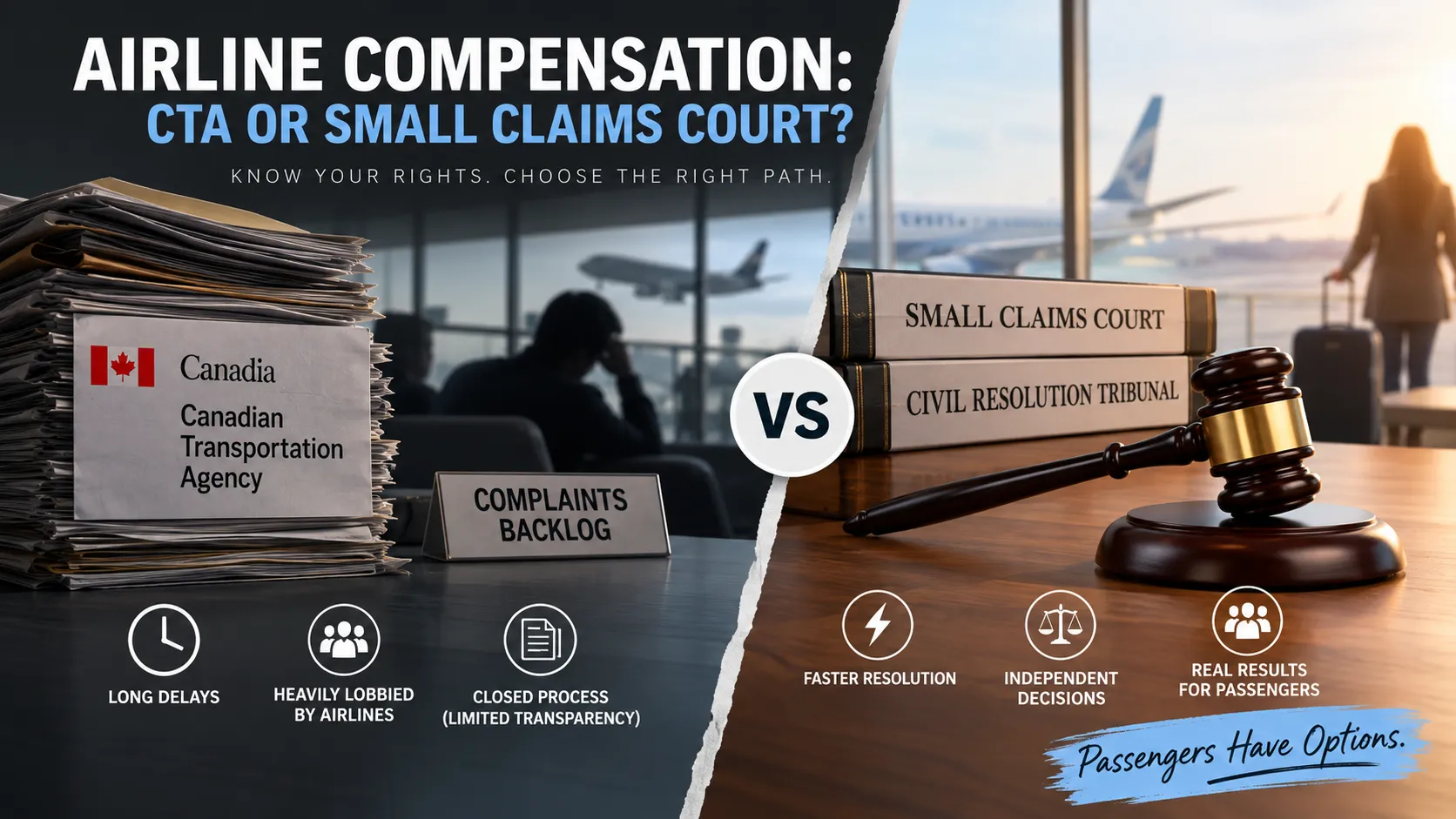
Why We Often Recommend Small Claims Court or a Tribunal Instead of the Canadian Transportation Agency
When an airline denies a valid passenger claim, the Canadian Transportation Agency is not necessarily your only—or your best—option.
When an airline denies a passenger’s claim for compensation under the Air Passenger Protection Regulations (“APPR”), many Canadians assume the next step is to file a complaint with the Canadian Transportation Agency (“CTA”).
That is understandable. The CTA administers Canada’s federal air passenger protection regime and operates a complaint process specifically designed for disputes between passengers and airlines.
But the CTA is not necessarily your only option.
For many straightforward monetary claims, particularly claims for standardized APPR compensation, passengers may also be able to pursue the airline through the Small Claims Court or civil tribunal available in their province.
At SkyGuard Legal, we believe passengers should seriously consider that option before automatically joining the CTA complaint queue.
There are several reasons.
The federal complaint system has developed an enormous backlog. It has historically operated under extraordinary confidentiality restrictions. Airlines participate in the regulatory system on an ongoing basis and have substantially greater institutional knowledge and resources than individual passengers. And provincial courts and tribunals provide an independent, public forum in which passengers can enforce legal rights directly against an airline.
That does not mean every passenger should sue.
It does mean that Canadians should understand that the CTA complaint process is only one possible route to enforcing their rights.
Small Claims Court is a recognized alternative
This is not simply SkyGuard Legal’s interpretation of the system.
In Air Passenger Rights v. The Attorney General of Canada, 2026 ONSC 3983, the Ontario Superior Court of Justice expressly stated at paragraph 8:
Air passengers may also pursue compensation in provincial Small Claims Courts.
The case concerned a constitutional challenge to the confidentiality rules governing the CTA’s newer Complaint Resolution Officer process, but Justice Hackland’s reasons provide an unusually useful examination of how the federal passenger complaint system actually works.
The Court recognized that passengers seeking compensation are not necessarily confined to the federal administrative process.
That matters.
A typical APPR compensation dispute may ultimately be very simple.
The passenger says:
The airline owes me $1,000.
The airline says:
No, it does not.
That is a dispute about a legal obligation to pay money—the sort of dispute provincial Small Claims Courts and civil tribunals routinely resolve.
Depending on the province, the amount claimed and the nature of the case, a passenger may therefore be able to ask an independent provincial adjudicator to determine whether the airline owes the compensation.
The CTA complaint backlog is enormous
One of the most important practical considerations is time.
The federal passenger complaint system has struggled with very large numbers of unresolved complaints for years.
Justice Hackland reviewed that history in Air Passenger Rights v. Canada.
When Parliament redesigned the complaint process in 2023, approximately 32,700 complaints were already awaiting determination, and the average resolution time was approximately 373 days.
The new Complaint Resolution Officer, or “CRO,” process was intended to make the system simpler, faster and more efficient.
The Court was not persuaded that this objective had been achieved.
At paragraph 33, Justice Hackland observed:
“there was no evidence provided to this court that the efficiency goal is being achieved.”
By 2026, the problem had become much larger.
At paragraph 34, the Court noted that the backlog had:
“recently approached 100,000”
complaints.
For an individual passenger seeking $400, $700 or $1,000 in compensation, that raises an obvious practical question:
Why wait in a federal administrative queue if an independent provincial court or tribunal is available to determine the claim?
The answer will depend on the circumstances of each case, but passengers should at least ask the question.
The federal process was supposed to be streamlined
The current CRO system was created in 2023.
Under that process, passengers generally must first make a written request to the airline. If the issue remains unresolved after 30 days, the passenger may submit a complaint through the federal system.
A Complaint Resolution Officer then deals with the dispute.
The process is conducted in writing.
Both the passenger and airline provide information. The passenger can reply to the airline’s position. If both parties agree, the CRO may attempt mediation.
If mediation does not occur or does not succeed, the CRO makes a binding decision.
The CRO can determine whether the airline complied with its obligations and can order compensation or a refund where appropriate.
The federal government argued in Air Passenger Rights v. Canada that this streamlined model was designed to make enforcement faster and more accessible.
But the Court noted an important reality: despite the reforms, the backlog continued to grow dramatically.
That should matter to a passenger deciding where to pursue a claim.
These are real legal disputes—not simply customer service complaints
The federal government argued in Air Passenger Rights v. Canada that the CRO process should not be treated like a conventional adjudicative tribunal.
The Court disagreed.
Justice Hackland identified several functions performed by CROs that are unmistakably adjudicative.
They include:
interpreting legislation, sometimes involving complex legal questions;
making findings of fact;
determining whether airlines complied with their APPR or tariff obligations;
deciding jurisdictional issues;
resolving procedural questions;
determining whether passengers are legally entitled to compensation;
issuing written decisions; and
making orders that can ultimately be enforced through the courts.
The Court concluded that the process remained, in substance, an adjudication of disputes between passengers and airlines.
That is important because it helps expose a misconception about APPR claims.
When an airline rejects a passenger’s compensation claim, the dispute is not simply a disagreement with customer service.
It can be a genuine legal dispute about whether the airline has complied with federal law.
Passengers should think about enforcement accordingly.
The federal complaint system has also suffered from a serious transparency problem
Perhaps the most important aspect of Air Passenger Rights v. Canada concerns transparency.
Section 85.09(1) of the Canada Transportation Act imposed a sweeping confidentiality requirement on the CRO complaint process.
It provided that matters relating to the handling of a complaint were to be kept confidential unless the passenger and airline agreed otherwise.
That confidentiality extended beyond settlement discussions.
It also affected the adjudicative process and CRO decisions.
Air Passenger Rights challenged that provision under section 2(b) of the Canadian Charter of Rights and Freedoms, arguing that the secrecy of the adjudicative process violated freedom of expression and the open court principle.
The Canadian Broadcasting Corporation intervened in support of the challenge.
The Ontario Superior Court agreed.
Justice Hackland concluded that the CRO process is sufficiently adjudicative that the open court principle applies to it.
The Court found that the blanket confidentiality requirement infringed section 2(b) of the Charter and could not be justified under section 1.
The Court therefore read down the legislation so that confidentiality would continue to protect the optional mediation component of the process, but would not extend to adjudicative records, including CRO decisions and orders.
That decision has significance far beyond an abstract constitutional issue.
Transparency matters because passengers need to know how the law is actually being applied.
Airlines have an information advantage
Justice Hackland also identified an important imbalance in the federal system.
At paragraph 35, the Court observed that airlines possess the information generated by the complaints made against them.
They can collect that information.
They can analyze it.
They can identify recurring issues, arguments and outcomes.
The Court contrasted that position with the situation faced by the media and public-interest organizations.
Because of the confidentiality rules, those organizations had been prevented from effectively examining the complaint system, identifying systemic problems and informing the public.
That creates an important asymmetry.
A major airline may deal with thousands of APPR claims.
It can develop institutional knowledge about:
which arguments passengers commonly make;
which defences are successful;
which factual patterns repeatedly arise;
how decision-makers treat particular types of disruptions;
what evidence matters; and
how different legal arguments perform.
The individual passenger ordinarily has none of that information.
They may be dealing with an APPR dispute for the first time in their life.
A transparent justice system helps reduce that imbalance.
Courts create public law
Provincial courts operate under the open court principle.
Court proceedings and decisions are generally public, subject to limited exceptions.
That transparency has enormous value in passenger-rights cases.
When courts publish decisions:
other passengers can read them;
lawyers can analyze them;
journalists can report on them;
public-interest organizations can identify patterns;
judges can consider earlier decisions; and
appellate courts can clarify disputed areas of law.
Over time, a visible body of jurisprudence develops.
That makes the law more predictable.
It also makes it more difficult for either side to repeatedly advance legal positions that have already been rejected without those earlier decisions being available for scrutiny.
If an airline argues that a particular type of crew shortage, mechanical problem, weather event or operational disruption falls outside its control, passengers should be able to see how courts have treated similar arguments.
That is one of the strongest reasons SkyGuard Legal supports the continued use of Small Claims Courts and provincial tribunals for appropriate passenger claims.
Passenger rights are stronger when the law governing them is visible.
Small Claims Court puts the passenger and airline before an independent adjudicator
There is also an institutional difference between bringing a civil claim and using the federal regulatory complaint process.
The CTA has several roles within Canada’s transportation system.
It administers transportation legislation, performs regulatory functions, develops and applies policies, deals with transportation industry participants and operates complaint-resolution mechanisms.
A provincial court has a considerably narrower role when it hears a passenger compensation claim.
Its task is essentially:
Determine the dispute between the passenger and the airline according to the applicable law and evidence.
That institutional separation has value.
The passenger is not asking the industry’s federal regulator to resolve the dispute through its administrative complaint machinery.
The passenger is bringing a civil claim directly against the airline and asking an independent adjudicator to decide whether the money is owed.
Airlines also participate extensively in the regulatory and political process
Canada’s major airlines are sophisticated and well-resourced corporations.
Like other major regulated industries, they maintain government-relations operations and participate in federal lobbying.
They communicate with government officials and regulators about aviation policy, legislation and passenger-protection rules.
There is nothing inherently improper about that.
Regulated companies are entitled to communicate with government and advocate for their interests.
But passengers should understand the structural imbalance.
An individual passenger may interact with the APPR system once.
An airline interacts with it every day.
Airlines have lawyers, regulatory specialists, government-relations professionals and extensive institutional knowledge.
They participate in consultations.
They monitor regulatory changes.
They deal repeatedly with the same government institutions.
They possess data from thousands of passenger claims.
That does not establish that CTA decision-makers are biased in individual cases, and SkyGuard Legal does not suggest otherwise.
The point is more fundamental.
When consumers have legal rights against a heavily regulated industry, access to an independent judicial forum provides an important additional means of enforcement.
Passengers should not have to depend exclusively upon the regulatory complaint system to enforce private monetary rights.
Litigation can force the real issue into focus
There is another practical advantage to commencing a civil claim.
It changes the nature of the conversation.
A passenger may spend months exchanging messages with an airline’s customer relations department.
The passenger says compensation is owed.
The airline says it is not.
The passenger asks for reconsideration.
Another denial follows.
At some point, repeating the same arguments accomplishes very little.
A civil claim asks a different question:
Will the airline pay the claim, settle it, or defend its position before an independent adjudicator?
If the airline chooses to defend the case, it may have to put forward evidence supporting its position and persuade the adjudicator that its defence is legally sound.
That does not mean passengers automatically win.
They do not.
Airlines have legitimate defences under the APPR.
A long delay does not automatically create a right to compensation.
There may be genuine weather events, safety issues, air traffic control restrictions, airport disruptions or other circumstances that affect liability.
A weak claim does not become a good claim merely because someone files it in court.
But where a passenger has a well-supported legal claim, litigation can ultimately produce something that repeated customer-service correspondence may not:
a binding decision.
Small Claims Court is not right for every passenger
SkyGuard Legal does not recommend that every passenger immediately sue an airline.
There are disadvantages to litigation.
Depending on the province and forum, passengers may have to:
pay filing fees;
arrange service of documents;
comply with procedural rules;
meet limitation periods;
prepare evidence;
participate in settlement conferences or hearings; and
potentially face some exposure to costs.
Jurisdiction also varies across Canada.
Some provinces use conventional Small Claims Courts.
Others have administrative or online civil tribunals for certain lower-value disputes.
In British Columbia, for example, many small civil claims fall within the jurisdiction of the Civil Resolution Tribunal rather than immediately proceeding in Provincial Court.
Passengers therefore need to identify the correct forum before starting a claim.
The CTA may also remain the preferable option in some cases, particularly where the passenger wants a federal administrative process or where the nature of the dispute makes the Agency’s specialized jurisdiction useful.
This should not be reduced to:
Court good. CTA bad.
The better question is:
Which forum provides the best practical way to enforce this passenger’s particular legal rights?
Our general approach
For a straightforward APPR compensation claim, we generally suggest that passengers think about the process in the following order.
1. Make a proper written claim to the airline
Give the airline an opportunity to resolve the matter directly.
Keep the response.
Save your itinerary, notifications, emails, screenshots and other relevant records.
2. Ask the airline to explain a denial
An answer such as “outside our control” is a conclusion.
It does not necessarily tell you what actually happened.
If the airline denies compensation, ask:
What event caused the disruption?
When did it occur?
How did it affect your particular flight?
How does the airline classify the disruption under the APPR?
What information supports that conclusion?
Understanding the airline’s actual position is important before deciding whether to proceed.
3. Evaluate your claim realistically
Not every delay or cancellation creates a compensation entitlement.
Review the facts.
Review the applicable APPR provisions.
Consider the explanation given by the airline.
A passenger should have a reasonable factual and legal basis for a claim before starting litigation.
4. Consider the Small Claims Court or civil tribunal available in your province
Determine:
whether the forum has jurisdiction;
its monetary limit;
filing and service requirements;
applicable limitation periods;
available remedies; and
potential cost consequences.
For an appropriate claim, this may provide a direct path to an independent adjudicator.
5. Treat the federal complaint process as one option—not automatically the default
The CTA process remains available and may be appropriate in many cases.
But passengers should make an informed choice rather than assuming that every APPR dispute must go through the federal complaint system.
Rights are only meaningful if passengers can enforce them
Canada can create strong passenger rights on paper.
Those rights have much less practical value if passengers cannot enforce them effectively.
The history described in Air Passenger Rights v. The Attorney General of Canada illustrates the problem.
A complaint system redesigned to improve efficiency nevertheless accumulated a backlog approaching 100,000 cases.
The system also operated under a blanket confidentiality regime that the Ontario Superior Court found violated the Charter.
At the same time, the Court expressly confirmed that:
“Air passengers may also pursue compensation in provincial Small Claims Courts.”
That sentence matters.
Passengers have choices.
The federal complaint system has an important role to play in Canadian air passenger protection.
But so do provincial courts and civil tribunals.
For a straightforward, well-supported claim for money, SkyGuard Legal believes passengers should seriously consider whether Small Claims Court or the applicable provincial civil tribunal offers a better route to enforcement.
Sometimes the most effective way to enforce a passenger right is not to join another regulatory queue.
It is to ask an independent adjudicator to decide whether the airline owes you the money.
This article provides general legal information only and is not legal advice. Small Claims Court and civil tribunal jurisdiction, procedures, limitation periods, filing requirements and potential costs vary across Canada. Passengers should determine the appropriate forum and applicable law before commencing a proceeding.
Case discussed: Air Passenger Rights v. The Attorney General of Canada, 2026 ONSC 3983.