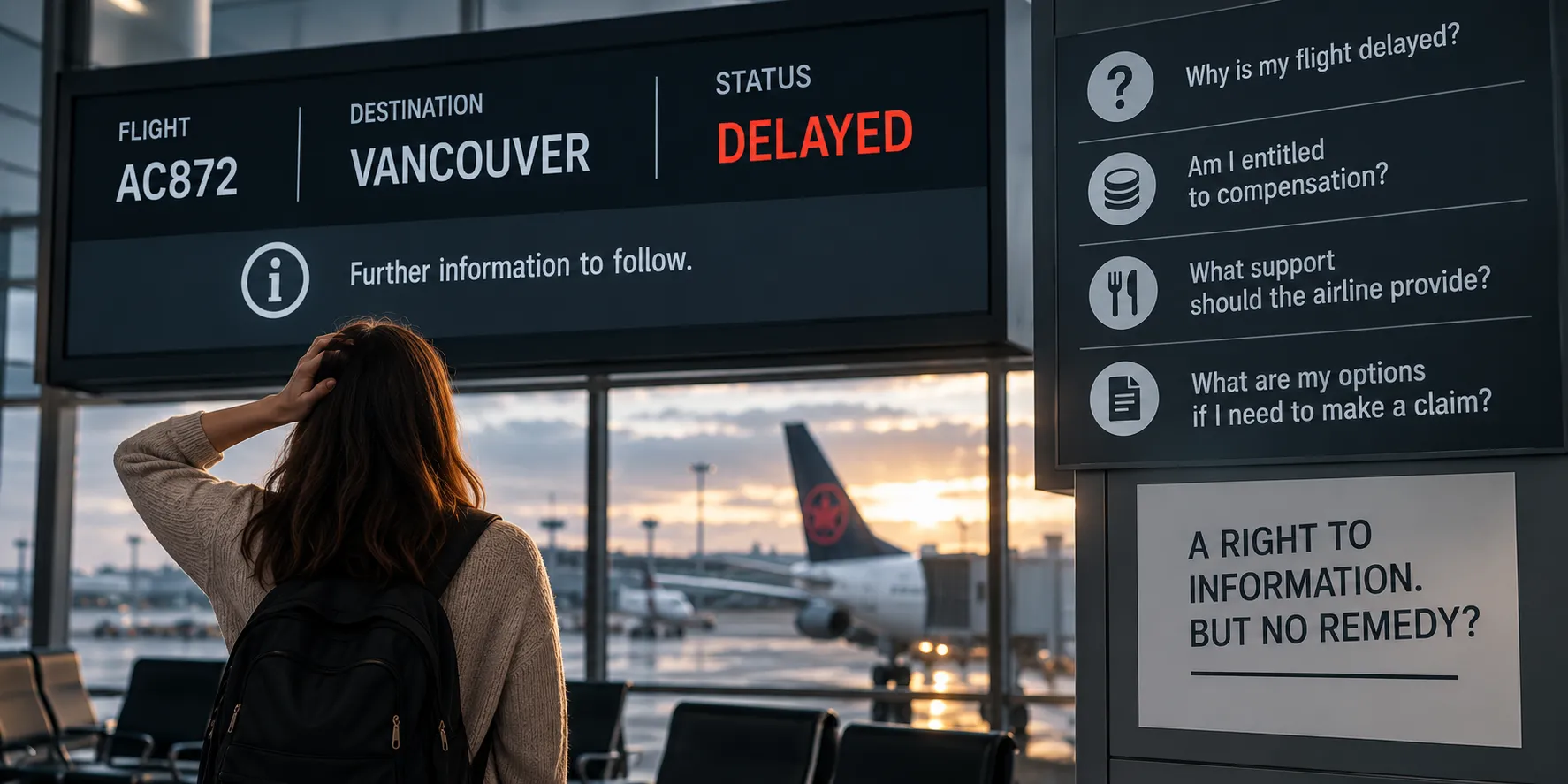
A Right to Information, But No Remedy: What Happens When Airlines Ignore Section 13
Section 13 of the APPR requires airlines to explain disruptions, provide regular updates, and tell passengers about compensation, treatment and recourse. But when airlines fail to provide that information, the passenger may have no automatic remedy for the breach itself.
A Right to Information, But No Remedy: What Happens When Airlines Ignore Section 13
Canada’s Air Passenger Protection Regulations (“APPR”) do more than require airlines to provide compensation, meals, hotels and alternate transportation in certain circumstances. They also give passengers a specific right to information when a flight is delayed, cancelled or boarding is denied.
That right appears in section 13. It requires airlines to tell affected passengers why the disruption occurred, what compensation may be available, what standards of treatment apply, and what recourse passengers have against the carrier. During a delay, airlines must also provide regular status updates and communicate new information as it becomes available.
These obligations are important because almost every other right under the APPR depends on information that is primarily in the airline’s possession. A passenger cannot meaningfully assess whether meals should be provided, whether another flight should be offered, or whether compensation may ultimately be payable without knowing why the disruption occurred and what the airline says the passenger is entitled to receive.
Yet section 13 contains an important weakness. It establishes a mandatory right to information without establishing fixed compensation for the passenger when the airline fails to provide it.
The result is another gap between a right created by the APPR and the practical remedy available when that right is ignored.
What section 13 requires
Section 13 applies when passengers are affected by a delay, cancellation or denial of boarding.
The airline must provide the reason for the disruption. It must also tell passengers about any compensation to which they may be entitled, the applicable standards of treatment, and the recourse available against the airline, including recourse through the Canadian Transportation Agency.
For delays, the obligation continues after the initial announcement. The carrier must provide status updates every 30 minutes until a new departure time has been established or alternate travel arrangements have been made. New information must be communicated as soon as feasible.
The regulations also address how that information is communicated. Required information must be announced audibly and, upon request, visibly. It must also be provided through an available communication method the passenger has indicated they prefer, including methods compatible with technologies used by persons with disabilities.
Section 13 is therefore considerably more substantial than a general instruction to “keep passengers informed.” It creates specific communication duties dealing with both the content and timing of information.
The reason for the disruption is not a minor detail
The requirement to explain why a flight was delayed or cancelled is particularly important because the APPR organizes many passenger entitlements around the cause of the disruption.
A disruption within the carrier’s control can produce different rights from one that is within the carrier’s control but required for safety. Both can produce different consequences again from an event outside the airline’s control.
The distinction can affect compensation, meals and accommodation, rebooking requirements and other obligations.
When an airline tells a passenger only that a flight is “delayed,” it has communicated very little of legal significance. Even statements such as “operational reasons” or “safety reasons” may provide limited assistance if they do not meaningfully explain what happened.
Passengers are not simply entitled to know that their flight is not leaving. Section 13 requires the carrier to provide the reason for the disruption.
That matters because information is what allows passengers to understand the rights that flow from the event.
The APPR creates an unusual information imbalance
Air passenger disputes involve a significant asymmetry of information.
The airline knows why an aircraft did not depart. It has access to maintenance records, crew scheduling information, operational logs, weather information, aircraft rotations and internal decisions. The passenger normally has none of those things.
At the airport, the passenger may know only that the departure board has changed from “On Time” to “Delayed” and eventually to “Cancelled.”
Yet the legal consequences of the disruption can depend heavily on facts that the airline alone possesses.
Section 13 can therefore be understood as an attempt to reduce that information imbalance. It requires the carrier holding the relevant information to communicate important parts of it to the passenger affected by the disruption.
Without that obligation, passengers would be placed in the peculiar position of having statutory rights that they could not realistically evaluate until long after the event.
The difficulty is that this problem is only partially solved if the law creates an information obligation without an effective passenger-facing consequence when the obligation is ignored.
What happens when the airline says nothing?
Suppose a flight is cancelled and the passenger receives a text message simply stating that the flight will not operate.
No meaningful reason is provided. There is no explanation of whether meals or accommodation are available. The passenger is not told about compensation or informed of the available complaint process.
The passenger spends the night arranging accommodation, purchasing food and trying to determine independently what the airline is required to provide.
Section 13 may have been breached. But the APPR does not provide a fixed payment specifically because the required information was withheld.
The regulations establish standardized compensation for certain delays and cancellations and separate compensation for qualifying denials of boarding. There is no equivalent provision stating that a passenger receives a particular amount because the airline failed to provide the information required by section 13.
That distinction is important.
An airline may owe compensation because of the underlying disruption. It may separately have breached section 13 by failing to explain the disruption or inform the passenger of their rights.
The second breach does not automatically increase the passenger’s compensation.
A regulatory violation is not necessarily a passenger remedy
Failure to comply with section 13 is not legally meaningless. The communication requirements are enforceable regulatory obligations, and breaches can attract administrative enforcement consequences.
That is an important part of the system. Regulatory penalties can discourage airlines from systematically withholding information and can reinforce the expectation that carriers comply with their communication duties.
But regulatory enforcement and individual compensation are not the same thing.
A financial penalty imposed on an airline because it failed to provide required information generally does not compensate the passenger who spent hours trying to determine what was happening or who made decisions without information the airline was legally required to provide.
The law may punish the carrier while leaving the passenger with no direct monetary remedy for the information breach itself.
Some losses may be recoverable, but causation becomes difficult
The absence of fixed compensation does not mean that a failure to provide information can never have financial consequences.
APPR obligations form part of the legal terms governing the carrier’s transportation service. Where an airline’s failure causes a passenger to incur expenses, there may be avenues through the complaint system or another appropriate forum to seek recovery of those losses.
The difficulty is proving what the information failure actually caused.
Suppose an airline fails to tell a passenger that meals should be provided. The passenger purchases dinner. The relationship between the breach and the expense may be relatively straightforward.
But consider a more complicated situation. The airline fails to explain the reason for a cancellation, and the passenger therefore does not realize that they may have enhanced rebooking rights. They accept a flight two days later when another arrangement should have been offered much sooner.
What is the value of the lost time?
Or suppose a passenger is not told about the available recourse against the airline and consequently gives up on a valid claim. How should the failure to provide that information itself be valued?
These questions are considerably more difficult than reimbursing a hotel receipt.
Information rights often protect people from making decisions in ignorance. Once the information has been withheld and the decision has been made, reconstructing what would otherwise have happened can be difficult.
That makes a claims-based remedy particularly imperfect for this kind of breach.
Information is most valuable when it is provided at the right time
Timing is central to section 13.
A passenger needs to know about meal entitlements while waiting at the airport, not three months later. They need to understand rebooking rights while alternative flights are still available. They need status information while deciding whether to leave the terminal, arrange accommodation or change other travel plans.
An explanation received after the journey is over may help resolve a later claim, but it cannot restore the choices that were available during the disruption.
That is why the requirement for regular updates matters.
A delay is an evolving event. An airline may initially expect an aircraft to depart in 45 minutes and later discover that a mechanical problem will take several hours to resolve. Section 13 recognizes that information can change and requires airlines to continue communicating rather than treating the first announcement as the end of their obligation.
In practical terms, stale information can sometimes be little better than no information at all.
Changing explanations create another problem
Passengers frequently report receiving different explanations at different stages of a disruption. An airport announcement may refer to maintenance, an email may later refer to operational requirements, and a compensation response may characterize the same event differently.
Not every change in explanation means that something improper occurred. Airline operations are complex, and the cause of a disruption may become clearer as events unfold. An initial diagnosis can legitimately change when additional information becomes available.
Section 13 anticipates that possibility by requiring new information to be communicated as soon as feasible.
The relevant issue is therefore not necessarily whether the airline’s first explanation remained unchanged. It is whether the carrier communicated meaningful and updated information as its understanding of the disruption developed.
That distinction protects both sides. Airlines should not be expected to know facts that have not yet been established, but passengers should not be left relying on an outdated explanation after the airline itself has learned something different.
Section 13 and the later compensation decision are different obligations
The information required during a disruption should also be distinguished from the airline’s later response to a compensation claim.
When a passenger submits a qualifying request for APPR compensation, the regulations establish a separate obligation requiring the carrier to respond within the prescribed period by either paying the compensation or explaining why it is not payable.
That is a post-disruption process.
Section 13 operates much earlier. Its purpose is to provide information while the passenger is dealing with the cancellation, delay or denial of boarding.
An airline therefore does not necessarily satisfy its section 13 obligations simply because it eventually provides a detailed explanation weeks later in response to a compensation request.
The timing serves a different purpose.
A later explanation may assist in adjudicating a claim. It cannot necessarily cure the practical consequences of failing to provide required information while the disruption was occurring.
The right to information supports every other passenger right
This is what makes the absence of a direct remedy particularly notable.
Information is not merely another item on the APPR checklist. It is often the mechanism that allows passengers to exercise the regulations’ substantive protections.
A passenger who does not know that meals are required may buy their own food or go without it. A passenger who does not understand the rebooking rules may accept transportation days later than necessary. A passenger who is not told that compensation may be payable may never make a claim.
In each case, the substantive right exists. But the passenger may fail to exercise it because the carrier did not provide the information necessary to understand it.
There is an obvious tension in a consumer protection regime that places substantial responsibility on passengers to assert their rights while simultaneously making their access to information dependent on the regulated business.
Section 13 attempts to resolve that tension.
The remedial structure does not fully complete the job.
This also creates a compliance problem
The issue extends beyond individual disputes.
Regulation works partly through incentives. If compliance carries a real cost while non-compliance creates only uncertain future consequences, regulated businesses may not face sufficiently strong incentives to comply consistently.
Providing detailed, individualized and frequently updated information during a major operational disruption is not effortless. Thousands of passengers may be affected simultaneously, information may be changing rapidly, and frontline employees may themselves be struggling to obtain accurate explanations.
Those realities explain why compliance can be difficult.
They do not make the obligation optional.
The question for regulatory design is whether the consequences of failing to provide required information are strong enough to ensure that communication remains a priority when operations become difficult.
Administrative enforcement helps address systemic non-compliance. But from the passenger’s perspective, there remains a significant difference between a regulator having the power to sanction an airline and the passenger having an effective remedy for the breach they personally experienced.
A better remedy should reflect the nature of the right
A future reform of the APPR could address this gap without treating every imperfect airport announcement as a major compensation event.
The law could distinguish between minor communication deficiencies and material failures that deprive passengers of information necessary to exercise other rights.
For example, a remedy could apply where an airline fails to provide the reason for a significant disruption, fails to communicate information about compensation or standards of treatment, or repeatedly fails to provide required updates over an extended period.
The objective would not be to create compensation for every late announcement. It would be to recognize that a meaningful information right requires a meaningful consequence when non-compliance materially affects the passenger.
A regulatory system should be capable of distinguishing between an occasional imperfect communication and a failure that effectively leaves passengers to navigate a disruption without information the law says they are entitled to receive.
Passengers should preserve the information they receive — and the information they do not
For passengers, section 13 disputes present an evidentiary challenge because proving that something was not communicated can be more difficult than producing a document showing what was communicated.
During a significant disruption, passengers should therefore preserve emails, text messages, app notifications and screenshots of the airline’s stated explanation. It can also be useful to record the timing of significant announcements and any changes in the reason given for the disruption.
The purpose is not to turn every airport delay into an evidence-gathering exercise. It is simply to preserve information that may later disappear.
Passengers should also distinguish between the underlying disruption and the airline’s communication about it. Whether a cancellation was within the carrier’s control is one issue. Whether the airline complied with its obligation to provide information about that cancellation is another.
An airline may ultimately prove that no compensation was payable for the disruption and still have failed to comply with section 13.
Information rights need practical consequences
Section 13 reflects an important principle of consumer protection law: people cannot effectively exercise rights they do not understand.
The APPR therefore requires airlines to explain why flights are disrupted, tell passengers about compensation and standards of treatment, identify available recourse, provide continuing updates during delays and communicate new information as it becomes available.
Those are meaningful obligations.
But when an airline fails to comply, the APPR does not provide the passenger with a corresponding fixed amount of compensation for the information breach itself. Regulatory enforcement may be available, and financial losses caused by the failure may sometimes be recoverable, but those mechanisms do not fully address the harm caused when passengers are denied information at the moment they need it.
The APPR gives passengers a right to know.
The remaining question is what that right is worth when the airline does not tell them.
This article provides general legal information only and is not legal advice. The rights and remedies available in any particular case depend on the circumstances, the applicable tariff and the forum in which a claim is brought.