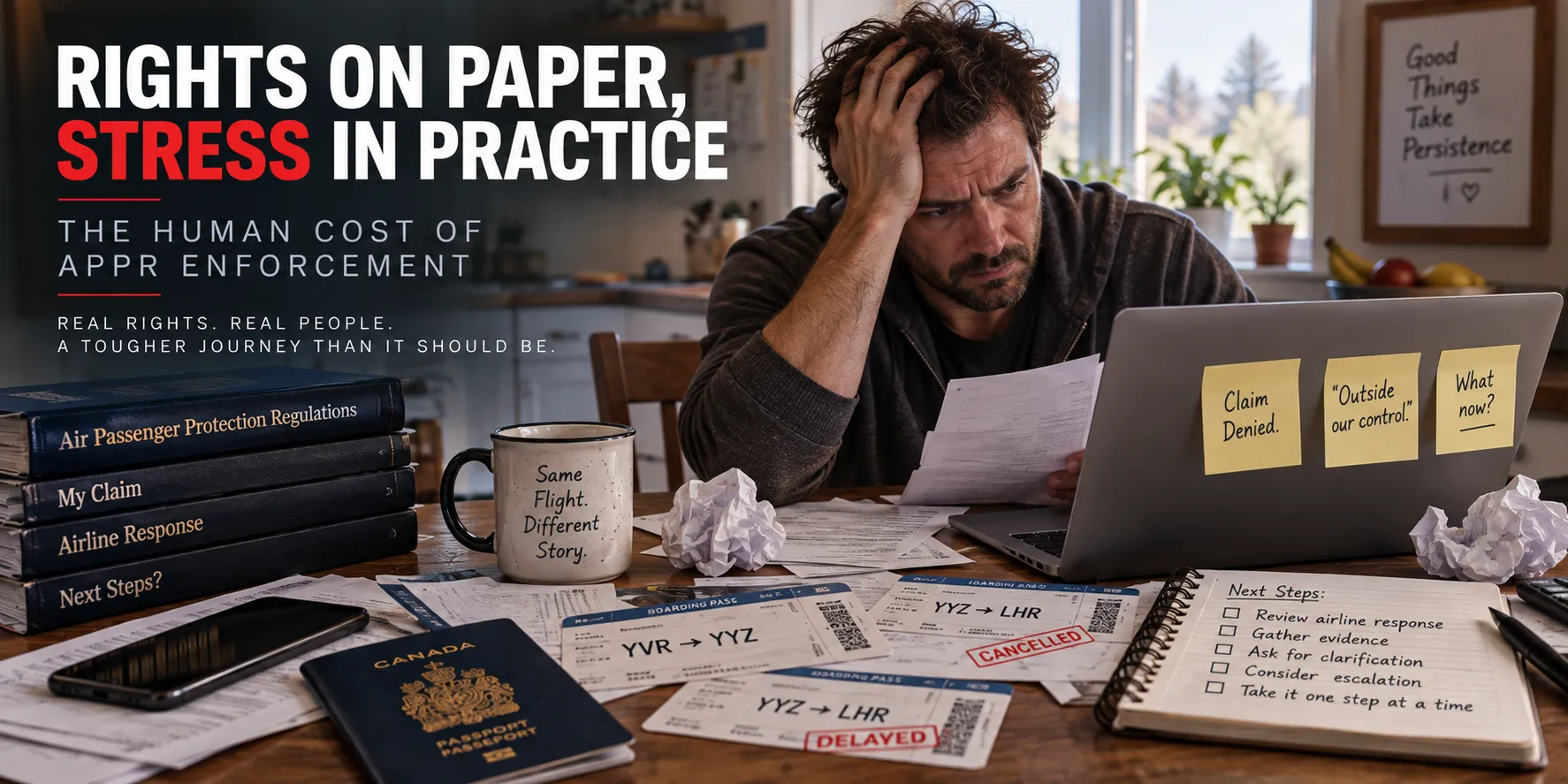
Rights on Paper, Stress in Practice: The Human Cost of APPR Enforcement
Canada’s air passenger rights may look straightforward on paper, but enforcing an APPR claim can demand time, persistence, organization and emotional energy. This article examines the human cost of a claims-based compensation system and why passengers should approach enforcement one step at a time.
Canada’s Air Passenger Protection Regulations (“APPR”) promise something that appears, at first glance, relatively straightforward. A passenger who experiences a qualifying disruption within an airline’s control may be entitled to standardized compensation of $400, $700 or $1,000 depending on the length of the delay. Those amounts are specific, concrete and easy to understand. What is much less obvious is the amount of work that may be required to turn that statutory entitlement into an actual payment.
The APPR is fundamentally a claims-based regime. In most cases, the passenger is not automatically identified, notified of their entitlement and paid. Instead, the passenger must recognize that a claim may exist, understand enough of the regulatory framework to pursue it, gather the relevant information, submit a claim, evaluate the airline’s response and decide whether to continue if the claim is denied. That structure places a significant part of the enforcement burden on the person who has already experienced the disruption. It also means that the practical value of the right depends not only on the law itself, but on the passenger’s willingness and ability to persist.
That persistence can carry a real human cost. A passenger may already have dealt with an unexpected overnight stay, missed connections, lost time with family, missed work or the simple exhaustion that comes with a badly disrupted journey. The regulatory process begins after all of that. What follows may include searching for records, reading unfamiliar legal language, comparing explanations, writing to the airline, waiting for responses and deciding whether to escalate. None of those tasks is necessarily overwhelming on its own, but over time they can turn a relatively modest compensation claim into a recurring source of frustration.
The difference between entitlement and payment
One of the central weaknesses of a claims-based system is that legal entitlement and actual payment are not the same thing. If compensation were automatic whenever an airline’s own records established that the legal test had been met, the process would be relatively simple. The airline would know which passengers were affected, how long they were delayed and why the disruption occurred, and it could issue the required payment without waiting for each passenger to identify and pursue the claim individually.
That is not generally how the current system operates. The passenger must usually take the first step. Some passengers will know the APPR well enough to do so; others will not. Some will start a claim and abandon it. Some will accept an airline’s denial even if they are unsure whether it is correct. Some will disagree with the denial but conclude that the time and stress involved in pursuing the matter further are not worth $400, $700 or $1,000.
This is not a minor procedural detail. It is an important feature of the enforcement model. A claims-based system places friction between the existence of the right and the receipt of the remedy, and every layer of friction creates the possibility that an otherwise valid claim will simply disappear.
The passenger usually begins from a position of fatigue
The emotional burden of enforcement is easy to underestimate because legal processes are often described in neutral procedural language. A claim is filed, a response is received, a request for information is made, a complaint is submitted, a hearing may eventually be scheduled. On paper, those steps seem orderly. In practice, they often begin after the passenger has already endured the most disruptive part of the experience.
A family may have spent an unexpected night in an airport hotel. A parent may have spent hours trying to keep tired children occupied while waiting for updates. A traveller may have missed an important meeting, appointment or family event. Someone returning home may already have lost a day to rebooking, waiting on hold, airport transfers and uncertainty. The passenger does not enter the compensation process fresh and eager to learn a regulatory scheme; they often enter it tired and annoyed, with a strong desire simply to move on.
The requirement to pursue compensation after the fact therefore imposes a second burden. The flight disruption may be over, but the dispute is not. The passenger must now reconstruct events, locate records, remember what was said, preserve screenshots and determine whether the explanation later provided by the airline matches what they were told at the airport. The claim becomes a new task layered on top of the disruption itself.
The denial changes the nature of the problem
For many passengers, the process changes substantially when the airline says no. Until that point, the passenger may have regarded the matter as a relatively simple compensation request. A denial transforms it into a dispute about facts, law and evidence.
The airline may say the disruption was caused by weather, air traffic control, safety concerns, a labour disruption, an earlier flight disruption, crew availability or circumstances otherwise outside its control. Sometimes the explanation is detailed and makes sense. More often it is little more than a label. A passenger who receives a response saying “outside our control” may then have to work out what event actually occurred, how that event affected the flight, whether the explanation changed over time and whether the airline’s legal classification is supported by the facts.
At that point, the passenger is no longer simply asking for money. They are assessing the merits of a legal position advanced by a sophisticated commercial party with access to far more operational information than they possess. That is a very different exercise from filling out a claim form.
Persistence becomes an informal condition of enforcement
The APPR does not say that compensation is available only to unusually persistent passengers, but a claims-based system can create that result in practice. The passenger who accepts the first denial is finished. The passenger who asks for clarification moves one step further. The passenger who sends a formal demand, files a complaint or commences proceedings moves further still. At each stage, some people drop out.
This means that two passengers on the same flight, with the same legal entitlement, may experience very different outcomes. One may know the system, preserve the evidence, challenge the denial and eventually receive compensation. The other may accept the airline’s initial response and receive nothing. The substantive law may treat them equally, but the enforcement structure can produce very different practical results.
That is one of the uncomfortable features of the regime. The right may be universal, but the burden of enforcing it is highly individualized. Knowledge, confidence, available time and tolerance for conflict can all affect the outcome.
The emotional cost is cumulative
The stress of enforcement rarely comes from one dramatic event. It usually comes from accumulation. A passenger receives a vague denial and writes back. There is no response for several weeks. The passenger sends another message. The airline repeats its earlier position. The passenger researches the APPR, reads decisions, tries to understand the correct forum, fills out forms and waits again.
None of those steps is necessarily severe. Together, however, they can turn a modest consumer dispute into a lingering source of mental clutter. Every new email revives the frustration. Every deadline demands attention. Every procedural choice creates another small decision. Over time, the question may shift from “Am I legally entitled to $1,000?” to “Do I really want to keep thinking about this?”
That shift is significant because it is precisely where otherwise valid claims can die. A passenger does not need to conclude that the airline is right. They need only conclude that continuing is no longer worth the aggravation.
The airline experiences the claim differently
The institutional asymmetry between passenger and airline is central to understanding the human cost of enforcement. For the passenger, the claim is personal and usually unfamiliar. For the airline, it is part of an ongoing system of claims administration.
A large carrier can standardize intake, create templates, train staff, maintain internal databases and develop repeatable processes for handling compensation requests. It can spread the cost of legal and regulatory expertise across thousands of claims. It can draft generic, boilerplate replies to law suit claims. The individual passenger cannot do that. They are learning the system for one dispute, organizing the evidence for one dispute and deciding whether one relatively modest claim is worth the effort.
That difference does not necessarily imply bad faith by the airline. It simply means that the same dispute imposes very different burdens on the two parties. The airline processes another file. The passenger lives with another unresolved problem.
Information imbalance makes the stress worse
The passenger also begins from an informational disadvantage. The airline knows where the aircraft was, why it was delayed, which crew was assigned, whether maintenance intervened, what happened on earlier sectors and what operational decisions were made. The passenger may know only that their flight was cancelled and that a later email attributed the disruption to “weather” or “operational reasons.”
That imbalance matters because uncertainty is stressful. A passenger may be unsure whether the airline is obviously correct, obviously wrong or somewhere in between. They may feel they are being unreasonable simply by asking questions because the airline appears to possess all the relevant information.
This is why meaningful explanations matter so much. A passenger should not be forced to choose between blind trust and blind litigation. They need enough information to decide whether the claim is worth pursuing. Without that information, even a strong legal right can become difficult to evaluate.
Not every claim should become a fight
Persistence should not be confused with stubbornness. Sometimes the airline is right. A severe weather event, air traffic control restriction, security incident or other genuine outside-control event may not result in standardized compensation. Continuing to fight simply because the answer is unfavourable can waste time and increase frustration.
The goal should be informed persistence. If the explanation is clear and supported, the passenger may reasonably decide to stop. If the explanation is vague, inconsistent or unsupported, asking for more information may be worthwhile. If the amount is significant and the evidence appears strong, escalation may make sense.
The important point is that passengers should make that decision consciously. They should not give up simply because the process feels intimidating or because the airline’s first response sounds authoritative.
Take the process one step at a time
One of the best ways to reduce the emotional burden is to stop thinking of the claim as one enormous undertaking. A passenger does not need to decide immediately whether they are willing to litigate the matter to judgment. They need only decide what the next reasonable step is.
If the denial is vague, ask for an explanation. If the explanation conflicts with what was said during the disruption, preserve the earlier messages and ask the airline to reconcile them. If the claim still appears strong, send a clear written demand. If that fails, review the available enforcement options. At each stage, reassess whether continuing makes sense.
This approach turns the process into a series of manageable decisions rather than a single daunting commitment. It also reduces the risk of reacting emotionally to every setback.
Organization helps more than people expect
A poorly organized claim quickly becomes more stressful than it needs to be. The simplest practical step is to create a single folder and keep everything there: the itinerary, airline messages, screenshots, compensation claim, denial, receipts, correspondence and any notes about what happened. A short chronology can be especially useful because it converts a confusing sequence of events into something concrete and understandable.
Good organization has legal value, but it also has psychological value. Once the file is under control, the passenger no longer has to hold the entire dispute in memory. The matter can be put away between steps, which is important because persistence does not require constant attention.
There is very little benefit in checking a claim portal repeatedly or rereading the airline’s denial every day. Once the next step has been taken, put the file down until there is something useful to do.
Keep the amount in perspective
Principle matters, but proportionality matters too. A passenger may feel strongly that the airline should not be allowed to avoid a $1,000 obligation, and that may be a perfectly reasonable reason to continue. But it is still a $1,000 claim. The process should not consume a vastly greater amount of time, money and emotional energy unless there is some broader reason the passenger considers important.
Different people will draw that line differently. Some enjoy advocacy and derive satisfaction from seeing a dispute through. Others will decide that the remaining value of the claim no longer justifies the effort. Neither choice is inherently wrong.
The key is to preserve control over the decision. The passenger should decide when the claim is no longer worth pursuing. The system should not make that decision for them through exhaustion.
Formal proceedings may actually reduce uncertainty
It may seem counterintuitive, but moving a dispute into a court or tribunal can sometimes make it easier to manage psychologically. Endless customer-service correspondence has no obvious endpoint. The passenger asks the airline to reconsider; the airline repeats its position; another message follows. The dispute can feel circular.
Formal proceedings create structure. There are defined issues, deadlines, procedural steps and eventually an independent decision. The passenger is no longer asking the airline to review its own answer. Both sides are presenting their positions to an adjudicator.
Litigation is not stress-free, and it should not be romanticized. But structure can be easier to manage than indefinite correspondence, particularly where the parties have already reached an impasse.
Claims-based enforcement inevitably produces attrition
The human cost of enforcement is closely connected to the economics of the APPR. In a claims-based system, every passenger who does not apply reduces the airline’s actual payout. Every passenger who accepts a denial reduces it again. Every passenger who decides that escalation is too stressful or time-consuming reduces it further.
That observation does not require any allegation that airlines deliberately attempt to exhaust passengers. The effect arises from the structure of the regime itself. Where compensation is not automatic, persistence affects outcomes.
This is why the distinction between formal entitlement and practical enforcement is so important. A regulatory system can offer significant rights and still underperform if consumers bear too much of the burden required to activate them.
Automatic compensation would change the experience considerably
A system of automatic compensation would not eliminate all disputes, but it would remove much of the burden from straightforward cases. Where the airline’s own records establish that a qualifying disruption occurred, the carrier could identify affected passengers and issue compensation without waiting for each individual to make a claim.
That would shift much of the administrative burden onto the party that already possesses the relevant information and operates the system at scale. Difficult cases involving mixed causes, weather, safety or earlier disruptions would still require adjudication, but routine cases would not depend upon passenger persistence.
The present claims-based approach places much more responsibility on consumers. That is a policy choice, and it carries human consequences.
Consumer protection should not depend on personality
A well-designed rights regime should not disproportionately reward the persistent, legally confident or unusually organized. The passenger who has three jobs, young children or limited time should not be less likely to receive compensation than the passenger who enjoys reading regulations and drafting demand letters.
Yet a system that requires repeated individual action risks producing exactly that outcome. The more steps required, the more the result depends on the passenger’s capacity to keep going.
That is not an ideal model of consumer protection. Rights should turn primarily on legal entitlement, not endurance.
The right to stop still belongs to the passenger
There is also dignity in deciding that a claim is no longer worth pursuing. Consumer rights include the right to enforce a claim, but they do not impose an obligation to do so. A passenger may reasonably conclude that the remaining money is not worth the stress, time or attention.
The important distinction is between choosing to stop and being worn down into stopping. A fair system should allow passengers to make an informed decision about whether to continue. It should not depend upon making the process so slow or frustrating that attrition does the work instead.
The bottom line
Air passenger rights do not exist only in legislation. They exist in the practical experience of people trying to enforce them on their own. The APPR may promise $400, $700 or $1,000, but the true value of those rights depends in part on what a passenger must do to obtain the money.
A claims-based regime inevitably transfers some of the enforcement burden to consumers. When a claim is denied, that burden can expand quickly into research, evidence gathering, correspondence, procedural choices and delay. That process has a human cost, and passengers should understand it before deciding how far they want to go.
The answer is not to give up at the first sign of resistance. Nor is it to turn every disputed claim into a personal crusade. The better approach is disciplined persistence: keep good records, ask sensible questions, take the next reasonable step, reassess as you go, and use an independent adjudicator when the dispute genuinely requires one.
Rights on paper matter. But rights that ordinary people can enforce without being consumed by the process matter more.
And if you decide to pursue a claim, remember that you do not have to fight the entire battle today.
You only have to take the next step.
Just make sure the process does not take more from you than the claim is worth.
This article provides general legal information and policy commentary only and is not legal advice.