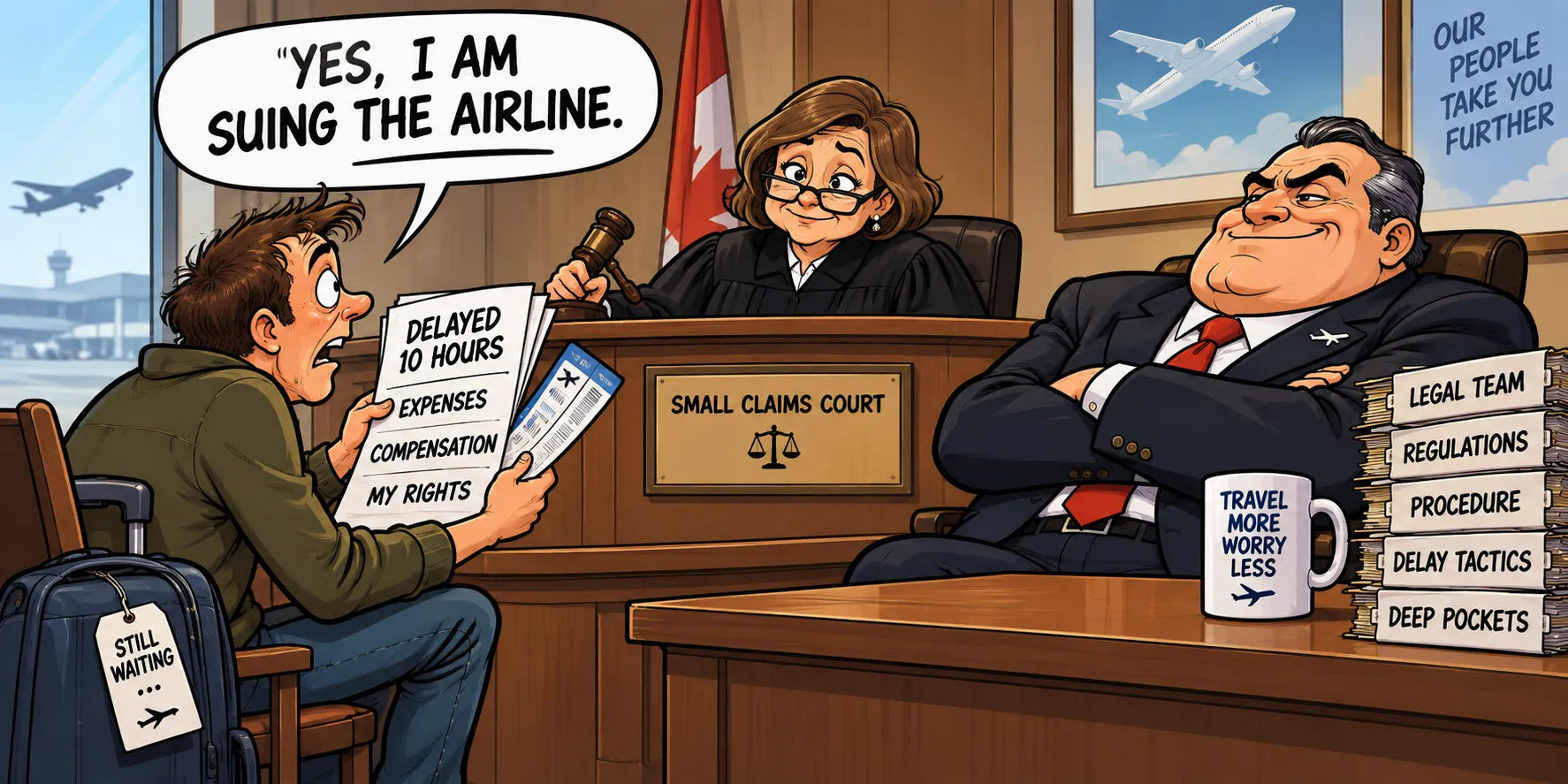
Can You Sue an Airline in Small Claims Court in Canada?
Yes, Canadian passengers may be able to sue an airline in provincial small claims court or a civil tribunal. This article explains when that option is available, how APPR compensation differs from damages, and what to consider before choosing a forum.
When an airline rejects a passenger’s claim for compensation or reimbursement, many travellers assume their only option is to file a complaint with the Canadian Transportation Agency.
That is not necessarily the case.
Depending on the province, the nature and value of the claim, and the circumstances of the flight, a passenger may be able to pursue an airline through a provincial small claims court or civil tribunal. In British Columbia, the Court of Appeal has now expressly confirmed that the Civil Resolution Tribunal can determine compensation claims arising from flight disputes under the federal Air Passenger Protection Regulations (“APPR”).
That does not mean every airline dispute belongs in small claims court. Airline cases can involve federal regulations, international treaties, contractual obligations, evidentiary questions, and provincial procedural rules. Before choosing a forum, it is important to understand exactly what is being claimed and what law creates the remedy.
Yes, provincial civil forums can hear APPR disputes
The most important recent authority in British Columbia is Air Passenger Rights v. WestJet Airlines Ltd., 2026 BCCA 357.
The case arose from an APPR compensation dispute that had been decided by the British Columbia Civil Resolution Tribunal. The BC Supreme Court concluded that the CRT lacked jurisdiction, but the Court of Appeal disagreed. The Court of Appeal held that the CRT had jurisdiction to determine the compensation claim and restored the CRT’s decision.
That is particularly important in British Columbia because the CRT generally handles small civil claims of up to $5,000. Provincial Court has a broader small-claims monetary limit of $35,000, although the interaction between the CRT and Provincial Court depends on the nature and amount of the particular claim.
Other provinces have different small claims systems, monetary limits and procedural rules. The exact forum must therefore be determined province by province.
The broader point is important: the existence of the federal APPR regime does not necessarily mean that every passenger compensation dispute must be decided exclusively by the Canadian Transportation Agency.
First ask: what are you actually claiming?
A disrupted trip can potentially give rise to several different claims.
A passenger may be seeking standardized compensation under the APPR, reimbursement of expenses, the cost of replacement transportation, damages arising from delay, compensation for lost or damaged baggage, or some combination of these.
Those remedies should not be treated as interchangeable.
A claim for $1,000 in standardized APPR compensation is legally different from a claim for $1,000 in actual financial losses caused by an international flight delay. The first arises from a Canadian statutory consumer-protection regime. The second may be governed by the Montreal Convention.
Identifying the legal basis for each amount claimed is therefore one of the most important steps before commencing a proceeding.
Standardized compensation under the APPR
Section 19 of the APPR provides standardized compensation for qualifying delays and cancellations that are within the carrier’s control and not required for safety, where the other statutory requirements are satisfied.
The passenger must submit a request for compensation to the carrier before the first anniversary of the delay or cancellation. Once the airline receives that request, subsection 19(4) gives it 30 days to either provide the compensation or explain why compensation is not payable.
Those requirements can be found directly in section 19 of the Air Passenger Protection Regulations.
Importantly, this is standardized compensation for inconvenience. A passenger does not have to prove that a nine-hour delay actually caused exactly $1,000 in financial loss.
APPR compensation is not the same as damages
That distinction was confirmed by the Supreme Court of Canada in International Air Transport Association v. Canada (Transportation Agency), 2024 SCC 30.
The airlines argued that applying the APPR compensation scheme to international flights conflicted with the Montreal Convention, particularly Article 29, which governs actions for damages within the Convention’s scope.
The Supreme Court unanimously rejected that argument. It concluded that the standardized compensation required by the APPR is not an “action for damages” within the meaning of Article 29. The APPR compensation scheme can therefore operate alongside the Montreal Convention.
This becomes important where a passenger wants both APPR compensation and compensation for actual losses.
Imagine a passenger who arrives more than nine hours late and satisfies the statutory requirements for $1,000 under the APPR. Suppose the passenger also incurred significant financial losses because of an international delay.
The APPR compensation claim and the claim for actual damages may rest on different legal foundations.
The Montreal Convention can govern international damages claims
The Montreal Convention forms part of Canadian law through the Carriage by Air Act.
The Convention governs important aspects of international carriage by air, including carrier liability for passenger delay and for lost, damaged or delayed baggage.
For claims that fall within its scope, the Convention can affect the cause of action, the damages available, the carrier’s defences, jurisdiction, and applicable deadlines.
One particularly important provision is Article 35. It provides that the right to damages is extinguished if an action is not brought within two years, calculated from the date of arrival at the destination, the date on which the aircraft ought to have arrived, or the date on which carriage stopped.
That language is significant. Article 35 does not simply establish an ordinary procedural deadline. It says the right to damages is extinguished if the action is not brought within the prescribed period.
Passengers contemplating litigation arising from international travel should therefore determine early whether the Montreal Convention applies.
The APPR creates several different kinds of rights
Another common mistake is to treat everything under the APPR as part of the $400, $700 or $1,000 compensation scheme.
It is not.
The APPR imposes several different types of obligations on airlines, including requirements concerning information, standards of treatment, alternate transportation, refunds and compensation.
For example, section 13 of the APPR requires a carrier to give affected passengers information about the reason for the disruption, possible compensation, applicable standards of treatment and available recourse. During a delay, the airline must also provide regular status updates until a new departure time is set or alternate arrangements are made.
Where the applicable statutory requirements are met, section 14 of the APPR requires reasonable food and drink and access to a means of communication after the passenger has waited two hours past the original departure time. Where an overnight wait is expected, the provision also addresses reasonable hotel or comparable accommodation and transportation to and from that accommodation.
Alternate travel arrangements are dealt with separately. Section 17 of the APPR sets out rebooking and refund requirements for disruptions within the carrier’s control, including disruptions required for safety. Different rules apply to disruptions outside the carrier’s control.
These rights can sometimes matter more to a stranded passenger than the eventual standardized compensation claim.
The reason for the disruption is often the real dispute
In many APPR cases, nobody disputes that the flight was delayed or cancelled.
The dispute is about why.
The Regulations distinguish among disruptions that are outside the carrier’s control, within the carrier’s control but required for safety, and within the carrier’s control and not required for safety.
Those categories are set out principally in sections 10, 11 and 12 of the APPR.
Classification matters because different legal consequences attach to the different categories.
An airline may attribute a cancellation to weather, maintenance, safety, crew availability, an airport restriction or an earlier disruption affecting the aircraft or crew. Determining whether that explanation actually satisfies the applicable APPR category can require considerably more information than the passenger has.
That illustrates one of the structural difficulties of airline litigation: the traveller knows what happened to the traveller, while the carrier often possesses much of the operational evidence explaining why it happened.
Keep the airline’s written response
Before commencing proceedings for section 19 compensation, the passenger must already have submitted the required compensation request to the airline.
The airline’s response may become important evidence.
Under subsection 19(4) of the APPR, the airline must, within 30 days of receiving the request, either provide the compensation or provide an explanation as to why compensation is not payable.
If the carrier says that a cancellation was caused by weather, the eventual dispute may concern whether weather actually caused the disruption and whether the airline correctly applied the Regulations. If the carrier relies on safety-related maintenance, different factual and legal questions may arise.
Passengers should retain the original claim, the airline’s response, and any subsequent correspondence in which the airline provides further or different reasons.
Evidence matters in small claims proceedings
A small claims proceeding is still litigation.
A passenger should be prepared to establish a coherent chronology supported by documents. Useful evidence may include the booking confirmation, itinerary, boarding passes, cancellation or delay messages, screenshots from the airline’s application, correspondence with the carrier, receipts, records of alternate flights and contemporaneous notes of conversations with airline representatives.
The objective is not simply to establish that the trip went badly. The decision-maker should be able to understand what was booked, what disruption occurred, what explanation the airline provided, what the airline offered, what the passenger requested, when the passenger ultimately arrived and how every amount claimed has been calculated.
The evidence needed will depend on the legal basis of the particular claim.
What about denied boarding?
Denied boarding has a different compensation structure.
The procedure is also different from ordinary delay and cancellation compensation. The Regulations require the carrier to provide denied-boarding compensation as soon as operationally feasible and, generally, no later than 48 hours after the denial of boarding.
That can significantly change the nature of a later court claim where the required compensation was never provided.
What about baggage claims?
Baggage claims also require separate analysis.
Under section 23 of the APPR, the compensation framework expressly refers to the Carriage by Air Act where that Act applies and uses the Montreal Convention framework in other circumstances specified by the Regulation.
International baggage claims can therefore involve the Montreal Convention directly.
They may also be subject to specific notice requirements and deadlines. A passenger should not assume that the rules governing a lost suitcase are identical to those governing standardized compensation for a cancelled flight.
Small claims court or the Canadian Transportation Agency?
The fact that a passenger may have access to a provincial court or tribunal does not mean that it is automatically the best forum.
The Canadian Transportation Agency operates a specialized federal complaint process for air-travel disputes. Provincial courts and tribunals operate under their own legislation and procedural rules.
The appropriate choice can depend on the remedy sought, the amount involved, the province, the evidence required, filing fees, potential cost consequences and the complexity of the legal issue.
A passenger should also be cautious about commencing multiple proceedings seeking to have different decision-makers determine the same dispute. Once a dispute has been finally adjudicated, legal principles concerning finality can prevent a party from simply trying the same case again in another forum.
Forum choice should therefore be deliberate.
British Columbia is a useful example
British Columbia illustrates why the phrase “small claims court” can be slightly misleading.
The Tribunal Small Claims Regulation sets the CRT’s small-claims limit at $5,000.
The Small Claims Court Monetary Limit Regulation sets the Provincial Court small-claims limit at $35,000.
Accordingly, a relatively modest BC airline claim will often start in the CRT rather than in a traditional courtroom. A larger claim may raise different procedural questions.
Other provinces organize their small-claims systems differently.
This is why passengers should identify the proper forum before filing rather than simply searching for the nearest courthouse.
Be careful with deadlines
Several different deadlines can potentially operate in an airline dispute.
For standardized APPR delay and cancellation compensation, subsection 19(3) requires the passenger to submit the compensation request to the airline before the first anniversary of the disruption.
For an action for damages governed by the Montreal Convention, Article 35 establishes the two-year extinguishment period discussed above.
Provincial civil causes of action may also be subject to provincial limitation legislation where another controlling limitation regime does not apply.
Those periods are not necessarily interchangeable. The applicable deadline depends on what legal right the passenger is attempting to enforce.
Waiting until the end of the second year to figure that out is an unnecessarily exciting way to practise limitation law.
Is suing the airline worth it?
Sometimes.
A strong small claim usually has a clearly identified legal basis, a manageable amount in dispute, useful documentary evidence and a reasonably focused disagreement.
A passenger seeking $1,000 of standardized APPR compensation after a disputed flight classification may have a very different case from someone seeking substantial consequential losses arising from an international itinerary involving several carriers.
The amount claimed may be small while the legal issue is surprisingly complicated.
That is why proportionality matters. Small claims procedures are designed to make modest disputes more accessible, but they cannot make every underlying legal question simple.
The broader significance of small claims jurisdiction
The ability to pursue an airline through a provincial court or tribunal matters beyond the individual case.
Consumer rights have practical value only if consumers have realistic ways of enforcing them.
The Canadian Transportation Agency plays an important role in the federal passenger-protection system, but the British Columbia Court of Appeal’s decision in Air Passenger Rights v. WestJet demonstrates that, at least in British Columbia, the CTA does not have exclusive jurisdiction over every APPR compensation dispute.
Provincial civil adjudication can therefore provide another route to enforcement.
For a passenger considering that option, the best question is not simply:
Can I sue the airline?
It is:
What am I claiming, what law creates the right, what evidence proves it, and which available forum is best suited to decide it?
For some Canadian passengers, the answer to that final question may indeed be small claims court.