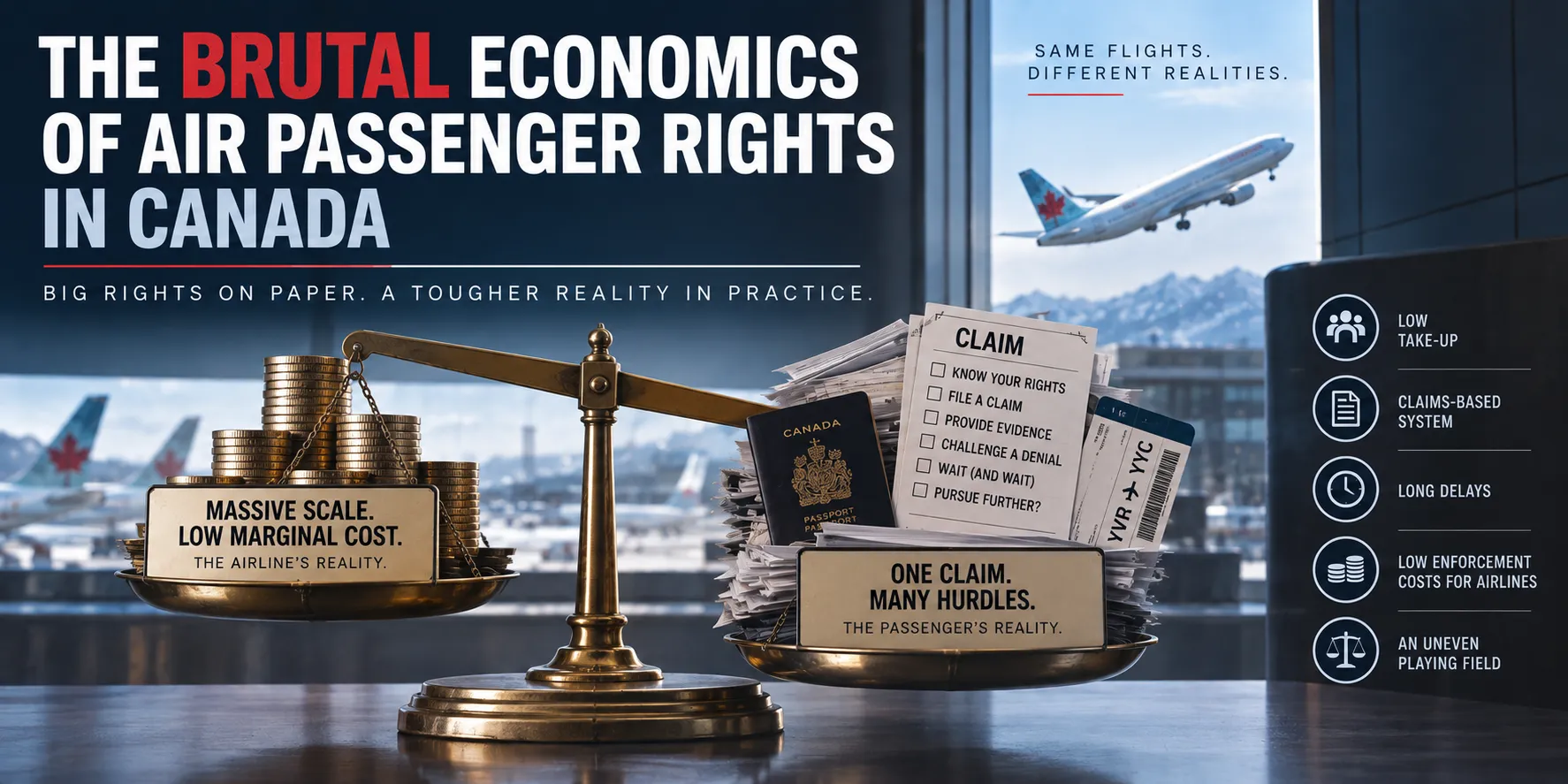
The Brutal Economics of Air Passenger Rights in Canada
Canada’s air passenger rules promise meaningful compensation, but the real economics favour airlines when passengers must identify, claim, challenge, and enforce their own rights. This article examines how friction, information imbalance, delay, and low follow-through can reduce the real cost of APPR claims.
Canada’s air passenger protection regime looks robust when viewed from the perspective of statutory entitlements. A passenger delayed by nine hours or more in circumstances within a large airline’s control may be entitled to $1,000 in compensation. Delays of six to nine hours may attract $700, and delays of three to six hours may attract $400. Those amounts are not trivial. They are large enough to suggest that airlines face a meaningful financial incentive to comply with the Air Passenger Protection Regulations (“APPR”), resolve valid claims promptly, and avoid unnecessary disputes.
But that is only one way to look at the economics of the system.
The more revealing perspective is to ask not what airlines may theoretically owe, but what they are likely to pay in practice. That distinction matters because the APPR is not, for the most part, a system of automatic compensation. It is a claims-based regime. The passenger must know that a right exists, recognize that their disruption may qualify, make the claim, assess the airline’s response, and decide whether to pursue the matter further if the claim is denied. At every stage, some passengers will stop. Some will never begin.
That attrition is not incidental to the economics of air passenger rights in Canada. It is central to them.
A legal entitlement is not the same thing as an expected payout
Consider a simple hypothetical. A flight carrying 180 passengers arrives more than nine hours late, and assume for the sake of illustration that every passenger would be legally entitled to $1,000 in standardized compensation. On paper, the airline’s potential liability is $180,000.
But the airline does not necessarily pay $180,000.
Some passengers may never hear about the APPR. Others may know that compensation exists but assume they do not qualify. Some will submit a claim. Some will abandon the process when asked for additional information. Some will accept the airline’s denial. Some will disagree with the denial but decide that pursuing $1,000 through a regulatory or civil process is not worth the time.
The theoretical liability and the actual payout can therefore be very different numbers.
That difference is where the economics become uncomfortable. A right worth $1,000 on paper may cost an airline much less than $1,000 in expected value if only a fraction of eligible passengers ultimately try to enforce it.
The system places the activation burden on the passenger
The APPR generally requires a passenger seeking standardized compensation to make a request to the airline. The airline then has an opportunity to pay or explain why it says compensation is not owed. That may appear procedurally reasonable, but economically it matters a great deal.
A system of automatic compensation and a system of claims-based compensation create very different incentives.
If compensation were automatic whenever an airline’s own records established that the legal test had been met, then the airline’s expected liability would track the actual number of affected passengers much more closely. If 150 passengers were entitled to $1,000, the likely cost would be $150,000.
In a claims-based system, however, the real cost depends on passenger behaviour. How many passengers file? How many complete the process? How many accept a denial? How many escalate? How many persist long enough to obtain an independent decision?
The economic value of friction increases with each step.
Friction is not neutral
Consumer-protection systems often assume that requiring a person to file a claim is a modest burden. In isolation, that may be true. But real-world behaviour tells us that every additional step filters people out.
The same principle applies everywhere. A rebate that requires a form is redeemed less often than a discount that is applied automatically at checkout. A warranty that requires multiple calls is less valuable in practice than one that is honoured immediately. A benefit that requires a consumer to gather documents, make a formal request, challenge a denial, wait for an administrative process, and possibly start litigation will be used by fewer people than a benefit that is automatic.
This is not because consumers are irrational. It is because time has value.
A passenger may be legally entitled to $400, but if obtaining it requires several hours of research, correspondence, document gathering, and potentially more formal enforcement, many people will decide that the claim is not worth pursuing. The same logic applies at $700 and $1,000, although the incentives change as the amount increases.
From the airline’s perspective, every passenger who stops reduces expected liability.
That is the brutal arithmetic.
Airlines process claims at scale; passengers do not
The asymmetry is even clearer when one considers the difference between how airlines and passengers experience the system.
For an individual passenger, a disrupted flight may be exceptional. They may never have made an APPR claim before. They may not know the difference between a disruption within the carrier’s control, one required for safety purposes, and one outside the carrier’s control. They may not know what evidence matters, what deadlines apply, or what forum is available if the airline says no.
For an airline, these are recurring transactions.
Large carriers handle claims continuously. They can standardize intake, automate parts of the process, develop response templates, retain specialized legal and regulatory staff, maintain internal disruption codes, and spread the cost of expertise across enormous numbers of flights and passengers.
The passenger bears the cost of learning the system for one dispute.
The airline amortizes the cost of understanding the system across thousands.
That matters because the party with the lower marginal cost of processing a dispute can afford to contest many more of them.
A denial may cost the airline very little
Suppose a passenger submits a claim for $1,000. The airline denies it. The denial may be generated through an established internal process at relatively low marginal cost. The claim has now reached an important economic fork.
The airline’s position has been stated.
The passenger must decide whether to continue.
At that point, the passenger may need to research the law, interpret the reason given, compare it with earlier communications, prepare a demand, file a federal complaint, or commence proceedings in a provincial court or tribunal. Even if the passenger has a strong claim, the practical burden has increased.
The airline, by contrast, may not incur significantly greater cost unless the passenger escalates.
That is one reason why enforcement mechanisms matter so much. A denial that is cheap to issue but expensive to challenge creates a structural advantage for the party issuing the denial.
The federal backlog changes the economic calculation
The existence of the Canadian Transportation Agency’s enormous complaint backlog makes the problem more pronounced.
A passenger deciding whether to challenge a denial must consider not only the amount at stake but also how long enforcement may take. A right to $1,000 is less valuable in practical terms if pursuing it requires joining a queue of tens of thousands of unresolved complaints and waiting a substantial period before adjudication.
Delay itself is a cost.
It reduces the present value of the claim, increases the psychological burden of pursuing it, and raises the likelihood that the passenger will abandon the process.
For an airline dealing with large numbers of claims, however, delay can have the opposite effect. The longer the path to enforcement, the greater the opportunity for attrition.
That does not mean delays are deliberately created to discourage claims. The backlog has obvious institutional causes. But whatever its cause, the economic effect is the same: the longer enforcement takes, the more difficult it becomes for ordinary passengers to convert legal rights into actual payment.
Information asymmetry compounds the problem
The economics of enforcement are also shaped by information.
The airline knows why the flight was disrupted. It knows where the aircraft was, what happened on earlier sectors, whether crew became unavailable, whether maintenance intervened, whether air traffic restrictions applied, and what internal records say about the event.
The passenger typically knows much less.
They may receive a text saying “operational reasons,” “weather,” or “outside our control.”
That creates an unusual situation. The party against whom the claim is made possesses much of the evidence needed to assess whether the claim is valid in the first place.
The passenger must then decide whether to challenge a denial without necessarily having access to the information required to test it.
That uncertainty has economic value too.
A vague explanation may be enough to end the process for a passenger who assumes the airline has access to facts they do not.
The system contains passenger-friendly rules, but they only matter if enforced
It is important not to overstate the case.
The APPR and related legislation do contain important protections for passengers. The compensation amounts are fixed. The federal complaint process includes evidentiary rules that can place the burden on the airline to establish that a disruption was outside its control. Rebooking, refund, communication and other obligations also exist.
Those are meaningful protections.
But a legal rule is only as effective as the process through which it is enforced.
A favourable burden of proof does not help the passenger who never files. A right to compensation does not help the passenger who accepts an unsupported denial. A strong statutory entitlement may have little real-world value if the cost of pursuing it exceeds what most consumers are willing to bear.
This is where the distinction between formal rights and effective rights becomes important.
The real question is not what the statute says; it is how many passengers get paid
The most useful measure of the APPR would not be the maximum compensation amount.
It would be the conversion rate between entitlement and payment.
Of every 100 passengers who are legally entitled to compensation, how many receive it?
How many never apply?
How many are denied?
How many denials are challenged?
How many challenged claims are ultimately paid?
How many passengers simply disappear from the system at each stage?
Those numbers would tell us far more about the effectiveness of Canadian air passenger protection than the face value of the statutory awards.
Yet publicly available data do not provide a complete picture of that funnel.
We know how many complaints reach the federal system. We know the backlog is enormous. We know airlines process large numbers of claims. What we do not appear to know, at least not transparently, is the percentage of legally entitled passengers who ultimately receive compensation.
That is not a minor data gap.
It goes to the heart of whether the regime works.
Small claims litigation changes the economics because it changes the cost structure
This is one reason provincial Small Claims Courts and civil tribunals are so important.
Before litigation, the airline may face relatively little additional cost from maintaining a denial.
Once a passenger commences formal proceedings, the economics change. Someone must review the file. Evidence may need to be assembled. A response may have to be drafted. An employee, representative or lawyer may need to participate. Settlement becomes a more serious consideration.
At that point, the airline’s marginal cost of continuing the dispute increases.
The imbalance narrows.
The problem, of course, is that the passenger must be willing to take the first step.
And most passengers did not book a flight because they wanted to learn civil procedure.
They have jobs, families, appointments, vacations and other responsibilities. A compensation regime that relies on individual litigation will inevitably lose claims through inertia, inconvenience and rational disengagement.
The structure creates an economic benefit from non-enforcement
It is important to be precise here.
The existence of these incentives does not prove that airlines deliberately deny valid claims as a systematic business strategy.
That would require evidence.
But one does not need to prove deliberate misconduct to identify the underlying incentive.
The structure itself creates an economic benefit whenever an entitled passenger fails to claim, accepts a denial, or abandons enforcement.
If an airline would theoretically owe $100,000 to a group of passengers, but only $40,000 is ultimately claimed and enforced, then the unclaimed $60,000 is an economic benefit to the airline regardless of why the other passengers stopped.
The incentive exists independently of intent.
That is what makes the issue systemic rather than anecdotal.
A hypothetical illustrates the point
Imagine a flight disruption affecting 200 passengers who would each be entitled to $1,000.
The theoretical liability is $200,000.
Assume 120 passengers file claims.
The active exposure has now fallen to $120,000.
Assume the airline pays 60 and denies 60.
Immediate payout: $60,000.
Assume only 20 of the denied passengers pursue the matter further.
Only $20,000 of the remaining theoretical liability is still being actively enforced.
These figures are hypothetical. They are not intended to represent actual Canadian claim rates.
But the structure of the example is what matters.
Every point of friction reduces expected payout.
That is why the percentage of passengers who follow through is economically more important than the statutory compensation amount alone.
Automatic compensation would fundamentally alter the incentives
If policymakers wanted to change the economics, the most obvious reform would be automatic compensation.
If an airline’s own operational records establish that a qualifying disruption occurred, the carrier could be required to identify affected passengers and pay them without waiting for individual claims.
That would remove the first and perhaps most significant point of attrition.
Other reforms could improve transparency. Airlines could be required to disclose how many passengers were affected by qualifying disruptions, how many claims were submitted, how many were approved, how many were denied, the reasons for denial, and how many denials were later overturned.
Those statistics would allow passengers, regulators, courts, policymakers and the public to measure the actual performance of the regime.
Meaningful penalties for systemic non-compliance would also alter the calculation. If the cost of improperly denying valid claims were limited to eventually paying the subset of passengers who persist, then underpayment could remain economically tolerable. If widespread non-compliance carried substantial additional penalties, the expected cost of improper denials would increase.
That is how regulation changes behaviour: not merely by creating rights, but by changing incentives.
The APPR’s central weakness may be one of enforcement design
The most serious criticism of the current regime is therefore not that it provides no rights.
It provides substantial rights.
The problem is that it relies too heavily on individual passengers to turn those rights into money.
The typical passenger must know, claim, interpret, challenge, escalate and persist.
The airline need only deal with the passengers who remain at each successive stage.
That is an unequal enforcement model.
And where one side operates at scale while the other participates only occasionally, the advantage is obvious.
The uncomfortable question
The success of Canadian air passenger protection should not be measured by how generous the regulations appear on paper.
It should be measured by what happens after a qualifying disruption.
Do passengers receive what the law says they are owed?
Promptly?
Consistently?
Without needing legal sophistication?
Without spending months or years pursuing a relatively modest claim?
If the answer is no, then the problem is not simply customer service.
It is regulatory design.
The brutal economics of air passenger rights in Canada are therefore not difficult to understand. Airlines face theoretical liabilities that can be substantial, but their actual costs depend on how many passengers make claims, how many claims are paid, how many denials are challenged, and how many passengers persist through the enforcement process.
Every passenger who drops out reduces the expected cost of the regime.
That is the uncomfortable reality.
A right that exists only for the unusually persistent is not a particularly strong consumer right.
And the true test of the APPR is not what it promises.
It is what passengers actually receive.
This article provides general legal information and policy commentary only. It is not legal advice.