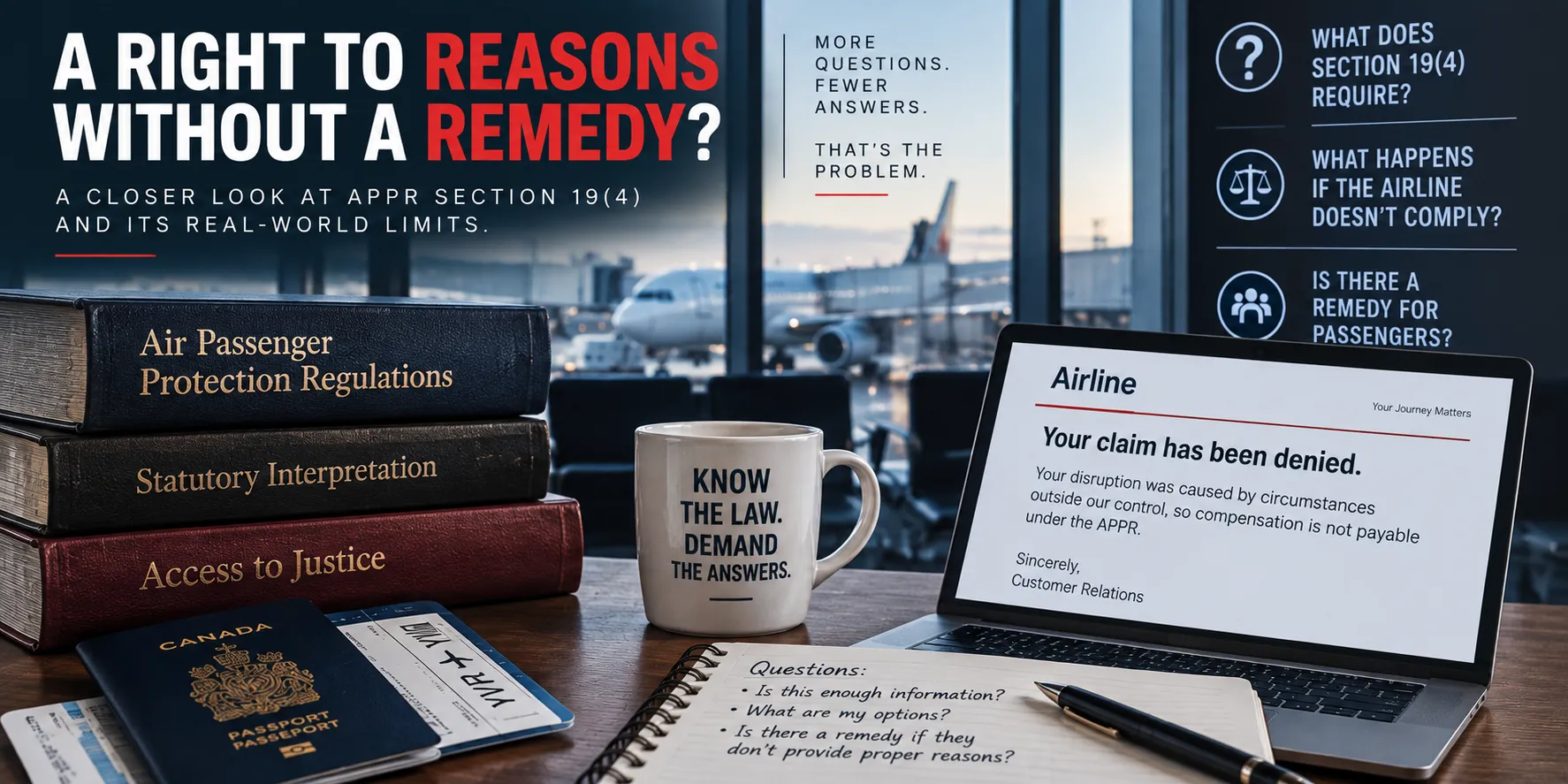
A Right to Reasons Without a Remedy? The Practical Weakness of APPR Section 19(4)
APPR s. 19(4) requires airlines to explain why compensation is not payable, but the passenger receives no automatic private remedy when that obligation is breached. This article examines why that gap weakens one of the APPR’s most important consumer protections.
One of the more promising provisions of Canada’s Air Passenger Protection Regulations (“APPR”) appears in subsection 19(4). When a passenger submits a request for standardized compensation following a qualifying delay or cancellation, the airline cannot simply ignore the request. The regulation provides that, within 30 days, the carrier must either pay the compensation or provide “an explanation as to why compensation is not payable.” Department of Justice Canada
On its face, this is an important consumer-protection measure. Airlines possess most of the information necessary to determine why a flight was disrupted, while passengers usually possess very little. The carrier knows where the aircraft was, which earlier flights it operated, what maintenance occurred, why a crew became unavailable, what operational restrictions were imposed, and which internal disruption codes were assigned. A passenger may know little more than that the departure board said “CANCELLED” and an email later attributed the disruption to “operational reasons.” Requiring reasons for refusing compensation should therefore perform an important function: it should allow the passenger to understand the airline’s position and make an informed decision about whether to accept it or challenge it.
The Federal Court of Appeal has now confirmed the importance of that obligation. In WestJet v. Lareau, 2025 FCA 149, the Court described the APPR as a passenger-rights regime “based on justification,” in which carriers must justify why compensation is not payable by applying the regulatory standards to the circumstances of the particular disruption. The Canadian Transportation Agency had previously taken a similar view, stating in Decision No. 122-C-A-2021 that an explanation under subsection 19(4) must contain sufficient information to permit a passenger to decide whether to challenge the rejection. Air Passenger Rights
The difficulty is not identifying the right.
The difficulty is determining what happens when an airline does not meaningfully respect it.
The promise of section 19(4)
Section 19 operates within the APPR’s compensation regime for delays and cancellations. A passenger generally has one year to request standardized compensation. Once that request is received, subsection 19(4) requires the carrier, within 30 days, either to provide the compensation or explain why compensation is not payable. Department of Justice Canada
Read purposively, the provision should prevent a peculiar form of self-adjudication. Without subsection 19(4), an airline could theoretically reject a claim by saying little more than “claim denied,” leaving the passenger unable to understand whether the airline was relying on weather, safety, maintenance, crew availability, an earlier disruption, air traffic control or some other event. The passenger would then face the unattractive choice of abandoning the claim or commencing proceedings largely in the dark.
The Agency’s own guidance has consequently contemplated considerably more than a conclusory response. Where multiple disruptions or causes are involved, its guidance says that an airline’s explanation should identify the different reasons, indicate the delay attributable to each, identify the affected flight or flights, state the primary reason for the passenger’s late arrival, and identify the regulatory category into which that reason falls. Canadian Transportation Agency
That is what makes subsection 19(4) potentially significant. It addresses an acute informational imbalance and, properly applied, gives passengers something they badly need: enough information to make an intelligent decision about enforcement.
The weakness is what comes next.
An important correction: section 19(4) is enforceable, but not in the way most passengers need
There is an important legal distinction here.
It would not be accurate to say that subsection 19(4) has no enforcement provision at all. It does.
The APPR designates subsection 19(4) as a provision for which an administrative monetary penalty may be imposed. The current schedule identifies a maximum penalty of $25,000 for a corporation and $5,000 for an individual for a contravention. Department of Justice Canada
That sounds substantial.
But it does not give the passenger $25,000.
It does not even necessarily give the passenger $1.
The administrative monetary penalty is a regulatory enforcement mechanism, not a private remedy payable to the traveller whose request was inadequately answered. Its effectiveness therefore depends on the regulator identifying the contravention, deciding to take enforcement action, and imposing a penalty.
That distinction changes the practical analysis considerably.
For the individual passenger, subsection 19(4) contains a right to an explanation but does not prescribe an additional amount of compensation payable to that passenger if the airline fails to provide one. There is no provision saying, for example, that a carrier which fails to give adequate reasons within 30 days must pay an additional $250. There is no statutory damages amount tied to the breach. There is no automatic escalation of the underlying compensation. Nor does subsection 19(4) itself say that failure to provide an explanation causes the underlying claim to be deemed admitted.
The legislation therefore separates the existence of the obligation from the private economic consequence of breaching it.
That is the real weakness.
What is the passenger supposed to do with a non-answer?
Consider the ordinary passenger’s position. They make a $1,000 APPR compensation claim following a delay of more than nine hours. Thirty days later, the airline sends a brief response stating that the disruption was “outside our control” and therefore compensation is not payable. Nothing identifies the event relied upon. Nothing explains when it occurred. Nothing connects that event to the passenger’s particular flight. Nothing explains whether the airline relies on an earlier disruption or what measures were taken to mitigate its effects.
There is a respectable argument that such a response does not satisfy subsection 19(4). Both the Agency’s interpretation and the Federal Court of Appeal’s description of the regime support the proposition that “reasons” require more than a bare conclusion. A justification regime is not much of a justification regime if the regulated party can satisfy it merely by repeating the legal category upon which the denial depends. Air Passenger Rights
But suppose the airline nevertheless refuses to provide anything more.
What has the passenger gained?
The passenger can complain. The passenger can point out the breach in subsequent proceedings. The passenger can invite the regulator to enforce the APPR. Depending upon the case, the inadequate explanation may also affect the credibility of the airline’s later position or the adjudicator’s assessment of evidence and costs.
What the passenger generally cannot point to is an APPR provision saying:
Because you breached subsection 19(4), you now owe me an additional monetary remedy.
That absence is significant.
Courts do not ordinarily invent statutory penalties
There is a broader legal principle at work. Canadian courts are understandably cautious about converting every breach of a regulatory statute into an independent right to damages.
The leading authority remains The Queen v Saskatchewan Wheat Pool, [1983] 1 SCR 205. The Supreme Court of Canada rejected the proposition that breach of a statutory obligation automatically creates a separate tort of breach of statutory duty. A statutory violation may be relevant to an established cause of action, including negligence, but the mere fact that Parliament imposed an obligation does not by itself create a private damages remedy whenever that obligation is breached. Supreme Court of Canada Decisions
That principle matters enormously in the context of subsection 19(4).
Parliament and the Governor in Council knew how to attach financial consequences to APPR obligations. Indeed, the regulations specify precise standardized compensation amounts elsewhere in section 19. The regulations also expressly designate subsection 19(4) for administrative monetary penalties. Department of Justice Canada
Against that legislative background, a court asked to invent an additional private penalty for failing to provide adequate reasons confronts an obvious difficulty. The regulatory scheme demonstrates that its drafters knew how to create both passenger compensation and regulatory penalties when they wished to do so.
They did not prescribe a private monetary remedy for breach of subsection 19(4).
A court may understandably hesitate before supplying one.
The paradox of a mandatory obligation without a passenger-centred remedy
This produces an odd result.
The word used in subsection 19(4) is “must.” The carrier must respond within 30 days. It must either compensate the passenger or provide an explanation. This is not framed as an aspirational best practice.
The Federal Court of Appeal has emphasized that the explanation requirement forms part of a regime based on justification. The CTA itself has said that passengers need enough information to decide whether to challenge the carrier. Air Passenger Rights
Yet from the passenger’s perspective, the immediate consequence of non-compliance may be remarkably small.
A carrier that pays nothing and gives inadequate reasons still holds the money.
The passenger must then do more work.
The passenger must write again, demand particulars, commence a complaint, or bring a civil proceeding. The passenger may have to spend hours researching a claim whose maximum standardized value is $400, $700 or $1,000.
The informational obligation intended to help the passenger decide whether to litigate may itself require litigation before it becomes meaningful.
That is not an especially elegant enforcement design.
The incentives are particularly weak at the initial claim stage
The practical problem becomes clearer when subsection 19(4) is viewed through the economics of claims administration.
Suppose an airline receives thousands of requests for compensation. Providing a genuinely individualized explanation requires some degree of investigation. Someone—or some sufficiently sophisticated automated system—must determine what caused the disruption, identify the relevant facts, connect those facts to the APPR, and communicate the resulting reasoning to the passenger.
A generic response is cheaper.
If a bare statement such as “weather,” “safety reasons,” “operational reasons,” or “outside our control” causes a substantial percentage of passengers to abandon their claims, the immediate economic incentive to provide detailed individualized reasons is weak unless the regulatory enforcement risk is sufficiently strong to counterbalance it.
That does not establish that any particular airline deliberately violates subsection 19(4). The point is structural rather than accusatory.
Regulation works partly by incentives.
If meaningful compliance costs money, while superficial compliance is cheaper, an effective regime requires a credible consequence for superficial compliance. A theoretical administrative penalty can supply that consequence—but only if enforcement is sufficiently frequent, predictable and substantial that carriers reasonably expect non-compliance to cost more than compliance.
For the individual passenger, there is little comfort in knowing that a regulatory penalty could theoretically be imposed if, in practice, the passenger still has to fight for the information needed to understand their own claim.
The regulatory penalty and the passenger’s remedy solve different problems
This distinction deserves emphasis because it is easy to conflate the two.
An administrative monetary penalty is designed primarily to secure regulatory compliance and deter future violations. The money does not compensate the passenger for the burden caused by the airline’s failure to explain itself.
A private remedy serves another purpose. It puts the affected person in a better position because their right was violated.
Subsection 19(4) clearly participates in the first model.
It does very little in the second.
If the Agency imposed a significant administrative penalty every time a carrier systematically sent inadequate responses, the deterrent function might be powerful. A carrier would know that generic denials carried substantial regulatory risk.
But that still would not make an individual passenger whole for having spent months trying to extract the explanation the regulation said should have been provided within 30 days.
The two mechanisms are complementary, not interchangeable.
Section 19(4) is particularly important because the airline controls the evidence
This weakness would matter less if passengers ordinarily possessed the facts necessary to assess their own claims.
They do not.
Much of the relevant evidence resides exclusively with the carrier. The airline knows the aircraft rotation, crew positioning, maintenance records, disruption chronology and operational decisions that may determine whether compensation is payable.
The passenger generally does not.
That makes reasons unusually important in air passenger disputes. Subsection 19(4) is not simply a courtesy provision requiring customer service to explain an unpopular decision. It is an information-forcing mechanism in a legal relationship characterized by extreme informational asymmetry.
Without meaningful reasons, a passenger can be forced to litigate simply to discover whether litigation was sensible in the first place.
The Federal Court of Appeal’s description of the APPR as a regime “based on justification” recognizes this point. Justification is valuable because it exposes the factual and legal foundation of the decision to scrutiny. Air Passenger Rights
But justification has regulatory value only when refusing to justify carries a meaningful consequence.
The proposed reforms reveal that the problem was recognized
The federal regulatory reform process has itself moved toward a considerably stronger model.
Proposed amendments published in the Canada Gazette would require, in certain circumstances, a clear and detailed explanation accompanied by documents, reports or other evidence establishing the exceptional circumstance relied upon by the carrier. Canada Gazette
That proposed approach is revealing.
It moves away from the minimalist idea that an airline satisfies its obligation merely by assigning a disruption to a regulatory category. Instead, it recognizes that an assertion should be supported by evidence.
That is a substantial improvement in principle.
But even a stronger evidentiary disclosure requirement will ultimately face the same fundamental question:
What happens when the carrier does not comply?
Consumer protection is only as effective as its enforcement architecture.
One possible solution: attach a private consequence to non-compliance
There are several ways a stronger regime could be designed.
One would be to provide a modest statutory payment directly to the passenger where the carrier fails to respond adequately within the prescribed period. The purpose would not be to punish minor technical defects. It would be to make the duty economically real.
Another possibility would be an evidentiary consequence. If a carrier failed to provide compliant reasons within 30 days, it could be prohibited from later relying on grounds or evidence that were reasonably available when the initial decision was made, absent exceptional circumstances.
A third possibility would be a rebuttable or conclusive presumption favouring the passenger where the airline fails to comply with the disclosure obligation.
Each model has advantages and disadvantages.
But each recognizes a basic regulatory principle: where one party exclusively controls information necessary to determine another person's legal entitlement, disclosure obligations should have meaningful consequences.
Otherwise, withholding the information may remain economically rational.
The current provision is not meaningless—but it is much weaker than it appears
It would go too far to describe subsection 19(4) as legally meaningless.
It establishes a statutory obligation.
It has been interpreted as requiring meaningful information.
The Federal Court of Appeal has incorporated it into its understanding of the APPR as a justification-based regime.
And, importantly, breach of subsection 19(4) is designated for administrative monetary penalties of up to $25,000 for a corporate carrier. Department of Justice Canada
Those things matter.
But the provision is considerably weaker from the individual passenger’s perspective than its mandatory language initially suggests.
Its practical effectiveness depends heavily on public enforcement. If the regulator does not enforce the explanation requirement consistently, the passenger has no simple substitute remedy built into subsection 19(4).
The passenger can insist.
The passenger can complain.
The passenger can litigate.
But those are precisely the burdens subsection 19(4) was supposed to help the passenger intelligently evaluate.
The deeper problem is remedial design
There is a recurring temptation in consumer legislation to focus on substantive rights while treating remedies as a secondary issue.
The two cannot be separated so easily.
A legal right without an effective remedy may still influence behaviour, establish standards and guide adjudication. But its practical value is inevitably diminished.
Section 19(4) illustrates the problem particularly well. The regulation tells airlines that they must explain why compensation is being denied. The Agency has interpreted that obligation substantively. The Federal Court of Appeal has described justification as an organizing feature of the compensation regime.
Yet the individual passenger who receives no meaningful explanation does not receive an automatic private remedy for that particular breach.
Courts are unlikely simply to manufacture a statutory penalty that the legislative scheme itself did not provide. Canadian law has long resisted treating breach of legislation as automatically creating an independent damages claim, and the structure of the APPR makes judicial improvisation particularly difficult because the regulations expressly prescribe financial remedies elsewhere. Supreme Court of Canada Decisions
That leaves enforcement largely where the regulatory scheme put it: with the regulator.
And therein lies the weakness.
The bottom line
Subsection 19(4) contains an important idea.
An airline that refuses compensation should have to explain why.
That requirement is particularly important in aviation because the airline controls most of the evidence necessary to determine whether its decision is correct. A passenger should not have to commence proceedings blindly simply to discover the facts upon which the airline relied.
But a right to reasons is only as strong as the consequences for refusing to give them.
The APPR does contain a regulatory enforcement mechanism: subsection 19(4) is a designated provision carrying potentially significant administrative monetary penalties. What it does not contain is a straightforward private consequence that benefits the passenger when the airline fails to provide the required explanation.
That distinction is critical.
A carrier may breach the passenger's statutory right to reasons without automatically increasing the amount owed to that passenger. The passenger must then invoke another process to enforce a right that was intended, at least in part, to help them decide whether invoking that process was worthwhile.
Section 19(4) therefore suffers from a familiar problem in consumer regulation: a strong statement of obligation coupled with a weak individual remedy.
Its language is mandatory.
Its purpose is important.
Its judicial interpretation is increasingly robust.
But unless regulatory enforcement makes non-compliance economically unattractive—or the law eventually gives passengers a direct remedy for the breach—the practical protection offered by subsection 19(4) will remain considerably less powerful than its text suggests.
This article provides general legal information and policy commentary only and is not legal advice.
Authorities discussed: Air Passenger Protection Regulations, SOR/2019-150, s 19(4); WestJet v Lareau, 2025 FCA 149; CTA Decision No. 122-C-A-2021; The Queen v Saskatchewan Wheat Pool, [1983] 1 SCR 205.