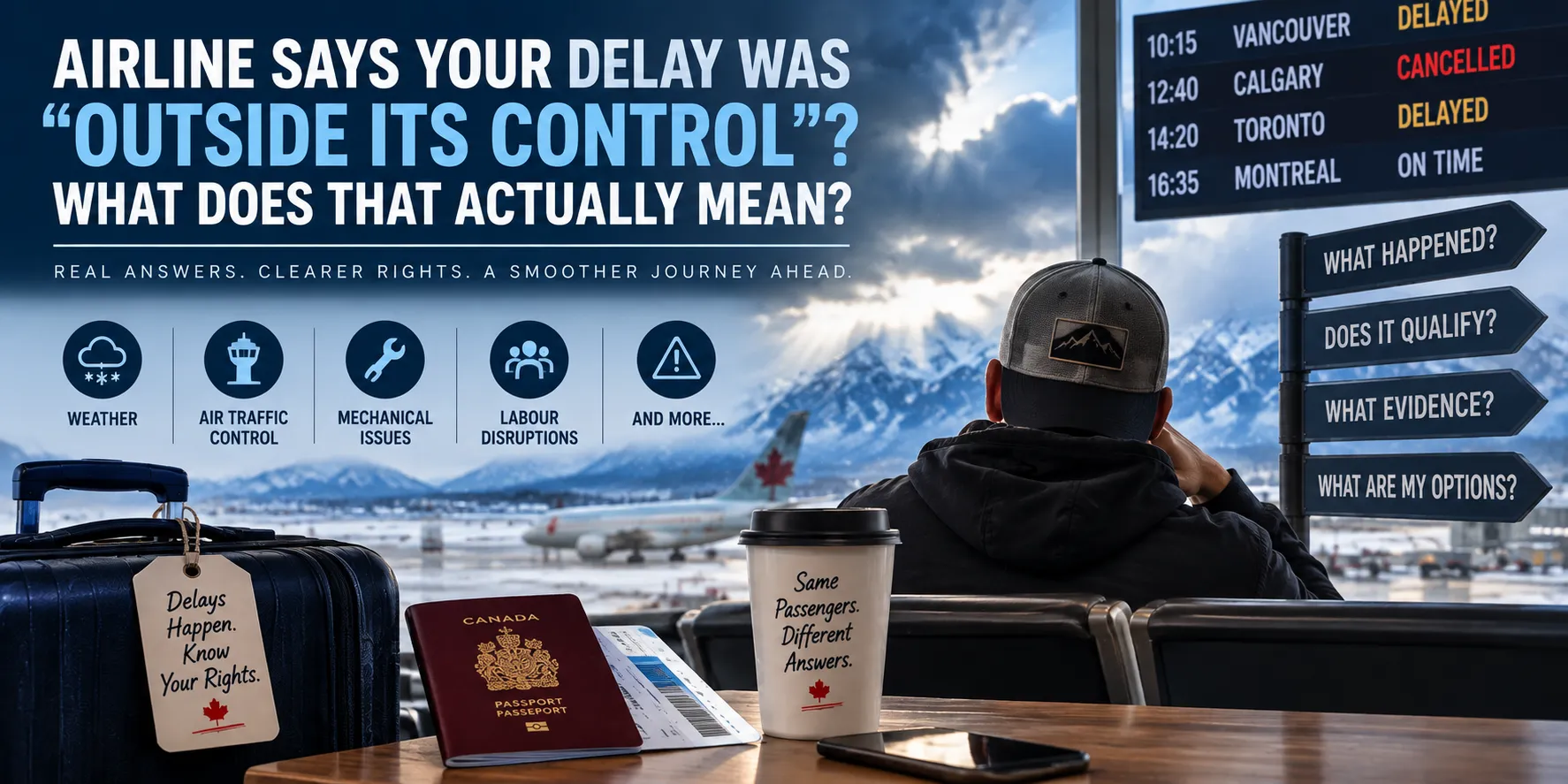
Airline Says Your Delay Was “Outside Its Control”: What Does That Actually Mean?
Airline says your delay was “outside its control”? Learn what that phrase actually means under the APPR, which events can qualify, how earlier disruptions matter, and what questions to ask before accepting a denied compensation claim.
You submit a compensation claim after a long flight delay.
A few days or weeks later, the airline responds:
Your flight disruption was outside our control. Compensation is not payable.
Well, that sounds official.
It also sounds like the end of the discussion.
But what does “outside our control” actually mean?
Under Canada’s Air Passenger Protection Regulations (“APPR”), those words have a specific legal significance. They are not simply a catch-all phrase meaning that something unexpected happened, operations became difficult, or the airline would really rather not pay your claim.
And when an airline denies compensation on that basis, passengers should understand what the airline is actually saying.
The APPR divides flight disruptions into different categories
For delays and cancellations, the APPR generally distinguishes between disruptions that are:
within the airline’s control;
within the airline’s control but required for safety purposes; and
outside the airline’s control.
That classification matters because standardized compensation for inconvenience generally applies to delays and cancellations within the airline’s control, subject to the other requirements of the regulations. Air Passenger Protection
So when an airline tells you that your disruption was “outside its control,” it is doing more than describing an unfortunate day at the airport.
It is making a legal classification that can determine whether standardized compensation is payable.
What does the APPR actually consider “outside the airline’s control”?
Section 10(1) of the APPR provides a list of examples.
They include:
war or political instability;
illegal acts or sabotage;
certain meteorological conditions or natural disasters;
instructions from air traffic control;
a NOTAM;
a security threat;
airport operation issues;
a medical emergency;
a collision with wildlife;
certain labour disruptions;
certain aircraft manufacturing defects; and
orders or instructions from government, law enforcement or airport security officials. Department of Justice Canada
The regulation says the list is “including but not limited to” those situations, so it is not necessarily exhaustive. Department of Justice Canada
But there is an important point here:
“Outside our control” does not mean “anything the airline did not plan.”
The airline should still be able to identify the event that caused the disruption and explain why it fits within the APPR.
“Operational reasons” does not tell you very much
Passengers often receive messages using language such as:
Your flight has been delayed due to operational reasons.
Or:
Your disruption was caused by an unexpected operational issue.
Those phrases may describe something that ultimately falls outside the airline’s control.
But they do not tell you what actually happened.
An operational problem could involve all sorts of things.
Was there:
an air traffic control restriction?
an airport closure?
a medical emergency?
severe weather?
a crew issue?
a maintenance problem?
a problem with the aircraft arriving from an earlier flight?
a staffing or scheduling problem?
Those facts matter.
If the airline later says the disruption was outside its control, ask it to identify the actual event.
Start with the facts, not the label
This is one of the most useful habits a passenger can develop.
Do not begin by arguing:
“That was within your control!”
First ask:
“What happened?”
Suppose an airline says:
Your delay was outside our control.
A useful response might be:
Please identify the specific event that caused the disruption, when and where it occurred, how it affected my flight, and the basis for classifying the disruption as outside the carrier’s control under the APPR.
That forces the conversation away from labels and toward facts.
Once you know the facts, you can start assessing whether the airline’s legal classification makes sense.
Some examples really are outside the airline’s control
There are obvious cases.
Suppose an airport is closed because of a security incident.
The airline did not cause that.
Or air traffic control instructs aircraft not to depart.
Again, the airline generally does not control air traffic control.
Or there is a serious weather event that makes the safe operation of the aircraft impossible.
Those are precisely the sorts of circumstances contemplated by section 10. Department of Justice Canada
Passengers should not approach every denial as if the airline must be trying to avoid paying compensation.
Sometimes the answer really is:
This was outside the airline’s control.
But that conclusion should follow from the facts rather than substitute for them.
What about mechanical problems?
This is where things can become more complicated.
Passengers sometimes assume:
Mechanical problem = outside airline control.
That is not what section 10 says.
One of the specific outside-control situations listed in the regulation is a manufacturing defect that reduces passenger safety and was identified by the aircraft manufacturer or a competent authority. Department of Justice Canada
That is much more specific than simply:
“The aircraft broke.”
Mechanical and maintenance issues can require careful analysis. The important questions may include what failed, why it failed, whether the issue was foreseeable, and how the APPR classifies the particular circumstances.
So if the airline says only:
Maintenance issue — outside our control,
that may be a reason to ask for more information.
What about crew shortages?
Again, the details matter.
“Crew issue” can describe very different things.
A crew member could become unexpectedly ill.
A crew might exceed legally permitted duty hours because an earlier flight was delayed.
The airline might have a scheduling problem.
An earlier disruption might have displaced aircraft and crew throughout the network.
There could also be a labour disruption.
Those situations should not automatically be treated as legally identical.
In fact, section 10 specifically identifies a “labour disruption within the carrier” or within certain essential service providers as an outside-control situation. Department of Justice Canada
But the phrase “crew unavailable” does not necessarily tell you whether there was a labour disruption—or what actually caused the crew to become unavailable.
Ask the next question:
Why was the crew unavailable?
What if the original problem happened to an earlier flight?
This is one of the trickier aspects of the APPR.
Your flight may have been disrupted even though the original event happened hours earlier, perhaps in another province.
Imagine your aircraft is scheduled to fly:
Toronto → Winnipeg → Calgary → Vancouver.
A major storm delays the aircraft in Toronto.
By the time the aircraft eventually reaches Calgary, your Calgary-to-Vancouver flight is several hours late.
The weather may be beautiful in Calgary.
That does not necessarily mean the airline cannot rely on the earlier weather disruption.
Section 10(2) specifically addresses earlier flight disruptions.
A later delay or cancellation that is directly attributable to an earlier disruption outside the airline’s control may also be considered outside the airline’s control—but there is another important condition:
the carrier must have taken “all reasonable measures to mitigate the impact” of that earlier disruption. Department of Justice Canada
Those words matter.
“It started with weather” is not necessarily the whole analysis
Suppose the original disruption genuinely was outside the airline’s control.
That does not necessarily allow the airline to attribute every later operational problem to that event indefinitely.
For section 10(2) to apply, the later disruption must be directly attributable to the earlier one, and the airline must have taken the required reasonable measures to mitigate its impact. Department of Justice Canada
That means passengers dealing with a knock-on disruption may reasonably ask:
What was the original disruption?
Which earlier flight was affected?
When did it happen?
How did it cause the disruption to my flight?
What steps did the airline take to mitigate the impact?
Were replacement aircraft or crews considered?
How much time passed between the original event and my flight?
The answer may still favour the airline.
But the existence of an earlier outside-control event does not make those questions irrelevant.
Watch for explanations that change
Imagine this sequence.
At 1:30 p.m., the airline tells you:
“Flight delayed due to crew availability.”
At 4:00 p.m.:
“Flight delayed due to operational requirements.”
At 7:00 p.m.:
“Flight cancelled.”
Three weeks later, your compensation claim is denied because:
“The disruption was outside our control due to weather.”
Those explanations might all form part of the same chain of events.
Perhaps severe weather stranded the incoming aircraft, the aircraft delay caused the crew to exceed duty limits, and that ultimately caused the cancellation.
That is possible.
But the airline should be able to explain the chain.
Do not assume inconsistent wording proves the airline is wrong.
Do preserve it.
Save the texts, emails, screenshots and notifications you received.
If the explanations materially change, ask why.
“Outside our control” does not mean the airline has no obligations
This is an important distinction.
Even where a disruption genuinely falls outside an airline’s control and standardized compensation is not payable, the APPR can still impose obligations on the carrier.
Section 10(3) requires certain information obligations and, depending on the circumstances, alternate travel arrangements or a refund. Department of Justice Canada
Section 18 sets out the rebooking and refund requirements that apply to outside-control delays and cancellations. For example, the regulation provides for a confirmed reservation on the next available qualifying flight, subject to the detailed requirements of that section. Department of Justice Canada
So:
No standardized compensation
does not necessarily mean:
The airline can wash its hands of you.
Those are different questions.
What information should you ask the airline for?
If your claim is denied because the disruption was outside the carrier’s control, consider asking the airline to identify:
the specific event that caused the delay or cancellation;
when and where that event occurred;
how the event affected your particular flight;
the provision or category under the APPR on which the airline relies;
whether the airline relies on an earlier flight disruption;
if so, how your disruption was directly attributable to that earlier event; and
what measures were taken to mitigate the impact of the earlier disruption.
You can also ask the airline to identify the information or operational records it relied upon when reaching its decision.
Keep the request reasonable.
You are trying to understand the basis for the denial, not demanding the airline empty its entire operations database onto your kitchen table.
Build a timeline
This can be surprisingly powerful.
Write down:
Original scheduled departure: 2:00 p.m.
First notification: 12:45 p.m. — “operational issue.”
Second notification: 2:30 p.m. — “crew availability.”
Cancellation: 5:15 p.m.
Replacement flight: following morning.
Final arrival delay: 14 hours.
Compensation denial: three weeks later — “outside our control due to weather.”
Now the problem becomes much easier to analyze.
Instead of a pile of airline messages, you have a sequence of events.
If the matter eventually goes before a court or tribunal, that chronology can also make your evidence much easier to understand.
Do not confuse the airline’s conclusion with an independent decision
This is perhaps the most important point.
When an airline says:
The disruption was outside our control.
that is the airline’s position.
It may be completely correct.
But the airline is not a court.
It is not the final independent adjudicator of a disputed legal claim against itself.
If you disagree with the denial after examining the facts and law, you may have options to pursue the matter through the Canadian Transportation Agency or, depending on the circumstances and your province, through Small Claims Court or a provincial civil tribunal.
A denial means the parties disagree.
Sometimes that disagreement ends there.
Sometimes it does not.
Before you escalate, be realistic
Not every denial deserves a fight.
If the airline shows that your flight was cancelled because air traffic control closed the airspace during a severe storm, continuing to argue that the disruption was within the airline’s control may not accomplish much.
On the other hand, if you received three different explanations and the eventual denial simply says “outside our control” without explaining what happened, it may be worth asking more questions.
The goal is not to turn every delayed flight into litigation.
The goal is to make an informed decision.
A simple way to think about it
When you receive an “outside our control” denial, work through four questions.
What happened?
Identify the actual event.
Not the classification.
The event.
How did it affect my flight?
Look for the causal connection.
Does the APPR treat that event as outside the carrier’s control?
Compare the facts with section 10.
If it came from an earlier disruption, did the airline mitigate it?
Section 10(2) makes that an important part of the analysis. Department of Justice Canada
If you cannot answer those questions from the airline’s denial, ask for more information.
The bottom line
“Outside our control” sounds definitive.
Sometimes it is.
A snowstorm, air traffic control restriction, security incident or other genuine outside event may mean standardized APPR compensation is not payable.
But “outside our control” is a legal classification, not an explanation of what happened.
Passengers should look beneath the label.
What event occurred?
When?
Where?
How did it affect the flight?
Was there an earlier disruption?
Was the later disruption directly attributable to it?
What did the airline do to mitigate the effects?
Those facts are what allow you to evaluate the airline’s conclusion.
So when the rejection email arrives saying:
Your disruption was outside our control.
you do not necessarily need to respond:
“No it wasn’t.”
A much better place to start is:
“Okay. What exactly happened?”
That question can tell you whether it is time to close the file—or whether there is more to the story.
This article provides general legal information only and is not legal advice. Entitlement to compensation and other remedies under the Air Passenger Protection Regulations depends on the facts of the particular disruption and the applicable law.