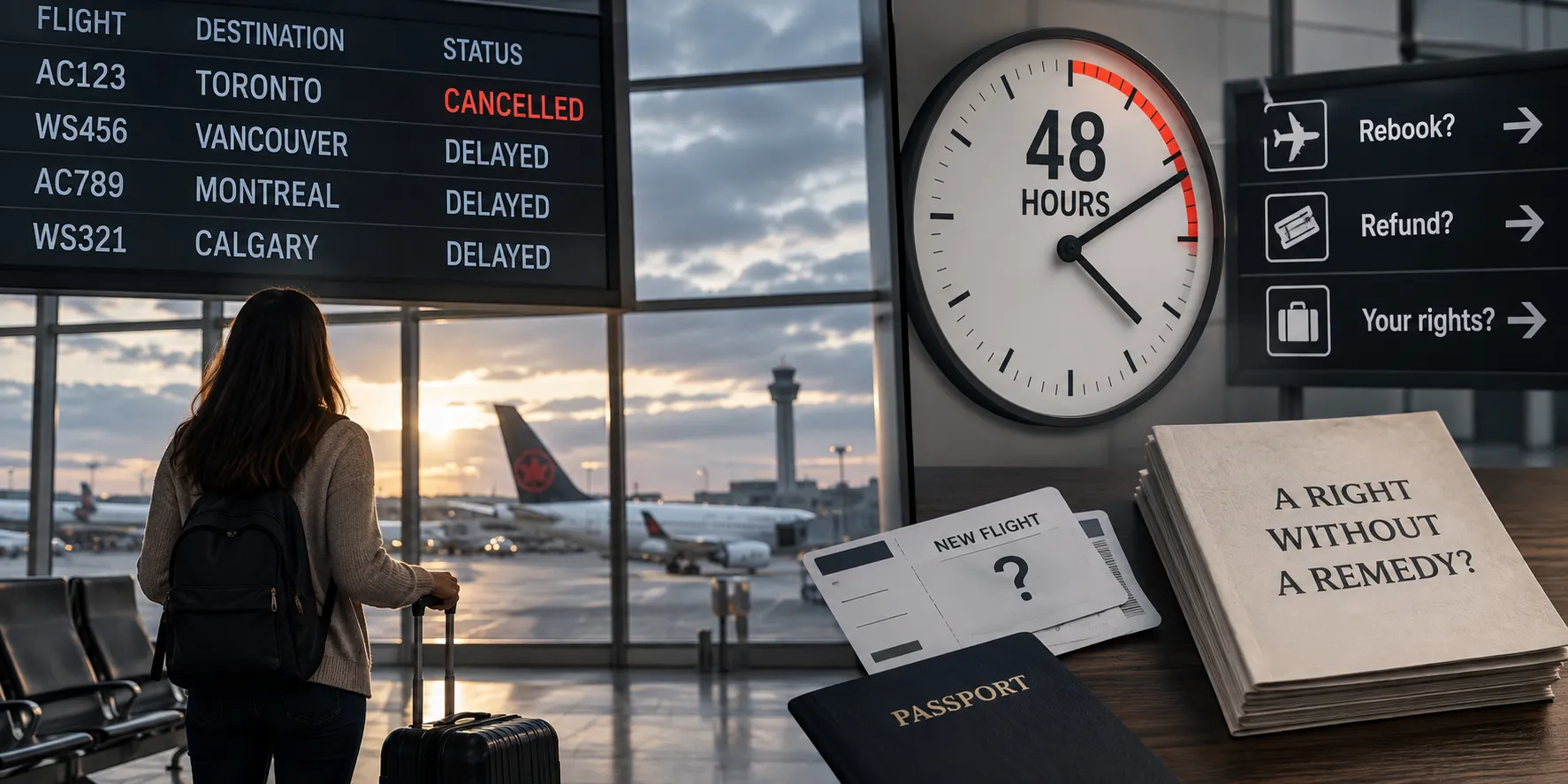
A Right Without a Remedy: What Happens When Airlines Miss the 48-Hour Rebooking Deadline.
The APPR requires airlines to rebook passengers within specific timeframes, including looking to other carriers in some cases. But when an airline fails to do so, the regulations provide no automatic compensation for the breach itself.
Canada’s Air Passenger Protection Regulations (“APPR”) contain detailed rules governing what airlines must do when flights are delayed or cancelled. Those rules do not merely require an airline to make reasonable efforts. In many circumstances, they specify when the carrier must look beyond its own network, when it must consider competitors, and when it must consider transportation from another airport.
The problem is what happens when the airline simply does not do it.
The APPR creates a clear rebooking obligation, but no corresponding fixed compensation specifically for breaching that obligation. A passenger may have other avenues of recovery, particularly where the failure causes additional expenses, but there is no straightforward provision saying that an airline which violates the 48-hour rebooking requirements must pay a particular amount.
That creates an important gap between having a right and having an effective remedy when that right is violated.
What the 48-hour rule actually says
The APPR does not simply say that every passenger must reach their destination within 48 hours.
For disruptions within an airline’s control, including those required for safety, section 17 creates escalating rebooking obligations. A large carrier must first provide a confirmed reservation on its own next available flight, or that of an airline with which it has a commercial agreement, on a reasonable route departing within nine hours of the passenger’s original departure time.
If that cannot be done, the obligation expands. The large carrier must provide a confirmed reservation on a flight operated by any carrier, travelling on a reasonable route from the same airport and departing within 48 hours of the original departure time. If even that cannot be provided, the regulations require transportation to another airport within a reasonable distance and a confirmed reservation from there. The objective is to complete the passenger’s itinerary as soon as feasible.
The 48-hour point is therefore better understood as a trigger for expanded obligations, not as the moment when the airline’s responsibility ends.
The rules differ somewhat where the disruption is outside the carrier’s control. Section 18 initially requires rebooking on the carrier’s own flight or that of a commercial partner within 48 hours. If that is not possible, the passenger must be offered further alternate arrangements or a refund. For a large carrier, those arrangements may involve another airline and, where appropriate, another nearby airport.
These are legal obligations, not customer-service aspirations.
What the rule is designed to prevent
Imagine a passenger whose flight is cancelled on Monday morning.
The airline offers another flight on Thursday evening. Meanwhile, seats are available on another carrier on Tuesday, or perhaps from an airport two hours away.
For a large carrier, the APPR is designed to prevent the airline from simply saying: “Our next available seat is Thursday, so Thursday it is.”
Depending on the classification of the disruption and the available alternatives, the airline may be required to buy transportation on another carrier or arrange travel from another nearby airport.
That matters because time is often the most valuable thing lost during a flight disruption. A refund of a $300 ticket is of limited comfort to someone who misses two days of a five-day vacation, a wedding, an important meeting or a cruise departure.
The purpose of the rebooking provisions is therefore not merely to return the cost of unused transportation. It is to get the passenger where the airline contracted to take them, within the framework the regulations require.
But what if the airline does not comply?
This is where the structure becomes less satisfactory.
The APPR provides standardized compensation for certain delays and cancellations within the carrier’s control. A large carrier may owe $400, $700 or $1,000 depending on the passenger’s arrival delay. But that compensation is tied to the nature and duration of the disruption. It is not a penalty imposed because the airline failed to comply with section 17 or section 18.
Those are different legal issues.
An airline may owe $1,000 because a controllable disruption caused a passenger to arrive more than nine hours late. Separately, it may also have failed to provide the rebooking required by the regulations.
The opposite scenario is even more revealing. A passenger may experience a disruption legitimately outside the carrier’s control and therefore have no entitlement to standardized compensation for inconvenience. Yet the airline may later fail to meet its mandatory rebooking obligations.
Suppose severe weather cancels a flight. The airline may bear no responsibility for the weather. But that does not eliminate its duties after the cancellation. If it fails to provide the required alternate transportation, the regulations do not automatically award the passenger $400, $700, $1,000 or any other set amount because of that breach.
That is the central gap.
The APPR compensates the disruption more clearly than the breach
The APPR is highly specific about what airlines must do, but far less specific about what passengers receive when airlines do not do it.
A qualifying controllable delay can trigger fixed compensation. A failure to provide required rebooking does not, by itself, produce a separate fixed payment.
That omission matters because a rebooking failure can cause substantial additional harm. A passenger who should have travelled Tuesday may instead leave Thursday. They may pay for meals, hotels, ground transportation or a replacement ticket. They may lose prepaid accommodation or other travel arrangements. They may also lose something that cannot readily be reduced to receipts: part of a vacation, attendance at an event, time with family, or the purpose of the trip itself.
The APPR does not assign a simple monetary value to the airline’s failure to honour that rebooking right.
Remedies exist, but they are more complicated
Calling this a “right without a remedy” requires some qualification. The passenger is not necessarily without any remedy.
A passenger may be able to recover expenses caused by an airline’s failure to comply with its legal or tariff obligations. If an airline improperly refuses to rebook someone and the passenger reasonably purchases a replacement flight or incurs additional transportation costs, those losses may form part of a claim.
But that is very different from standardized compensation.
Expense recovery usually requires the passenger to prove actual financial loss. The passenger must show what was spent, why it was reasonable, and how the expense resulted from the airline’s failure.
The carrier’s obligation is mandatory. The passenger’s remedy is largely compensatory and claims-based.
That distinction matters.
Regulatory enforcement does not necessarily help the individual passenger
There is also a regulatory enforcement mechanism. Failures to comply with rebooking obligations can attract administrative consequences, including financial penalties.
That may deter non-compliance and encourage better practices. But a penalty imposed on an airline does not necessarily compensate the passenger who was stranded for several days.
Regulatory enforcement and passenger compensation serve different purposes.
The regulator may punish the breach. The passenger may still have to pursue their own loss.
The passenger often has to fix the airline’s breach
This produces a particularly awkward result in practice.
A passenger standing in an airport is rarely interested in developing a legal argument. They need transportation.
If the airline says its next available flight is three days away while seats are visibly available on another carrier the next morning, the passenger may have to choose between accepting the inadequate rebooking, continuing to argue with airline representatives, or spending hundreds or thousands of dollars on replacement transportation and trying to recover the money later.
That shifts both cost and risk onto the passenger.
If they buy the alternative themselves, the airline may later dispute whether the expense was reasonable, whether another option existed, or whether the carrier had actually breached the regulations. The passenger must preserve receipts, screenshots, itineraries and evidence of what was offered.
A rule intended to require the airline to arrange replacement transportation can therefore become a claim in which the passenger arranges it, finances it and later seeks reimbursement.
That is not the same as effective compliance.
The gap is especially obvious when the original disruption was outside the carrier’s control
The distinction is particularly important where the airline did nothing wrong in causing the original disruption.
The APPR separates responsibility for causing a disruption from responsibility for dealing with its consequences. An airline may have no control over severe weather, an airport closure or an air traffic restriction. That can legitimately affect whether compensation for inconvenience is payable.
But rebooking is a separate issue.
The fact that the airline did not cause the cancellation does not mean it has no obligations afterward. Section 18 exists precisely because passengers still need to complete their journeys when events outside the carrier’s control occur.
That can lead to a striking result: the airline may be blameless for the cancellation but legally responsible for what happens next. Yet if it fails to rebook the passenger properly, there is no automatic compensation tied specifically to that breach.
The law recognizes the duty.
It simply does not attach a simple passenger-facing financial consequence to violating it.
Courts and tribunals may still matter
Passengers should not assume that every APPR dispute must be resolved through a single federal process.
Depending on the claim, provincial courts or tribunals may also have jurisdiction. An airline’s tariff, the APPR, ordinary principles of contractual damages and, on international itineraries, the Montreal Convention may all become relevant.
That makes rebooking disputes more complicated than the familiar $400, $700 or $1,000 compensation claim.
The central problem remains the same. Legal avenues may exist, but the regulations do not convert the rebooking breach itself into a simple standardized payment.
Why this matters as regulatory design
Passenger protection works best when three things line up: the obligation is clear, non-compliance can be established without disproportionate difficulty, and the remedy creates a meaningful incentive to comply.
The APPR performs reasonably well on the first point. The rebooking obligations are detailed. Large carriers may be required to consider other airlines and, in some circumstances, other airports.
The weakness appears at the remedial stage.
A rule can be mandatory in law but weak in practice if the consequences of ignoring it are uncertain, delayed or dependent on passengers pursuing individual claims months later.
That matters because compliance may be expensive. Buying a last-minute ticket on a competitor can cost an airline hundreds or thousands of dollars. Keeping the passenger on its own network several days later may cost much less.
A regulatory system should not create circumstances where compliance is expensive but the practical consequences of non-compliance are uncertain.
Most passengers will never litigate a rebooking decision. Many will not know what sections 17 or 18 require. Others will decide that recovering several hundred dollars is not worth the effort.
Effective consumer protection must account for that reality.
A better approach would attach a remedy to the right
Future reform could address this gap in several ways.
The regulations could establish standardized compensation for serious breaches of rebooking obligations. Compensation could increase depending on how long compliant alternate transportation was withheld. Another option would be a clearer statutory right to recover the reasonable cost of self-arranged replacement transportation when the airline fails to act within the prescribed framework.
The precise mechanism is a policy choice.
The principle is more important: where the law gives a passenger a concrete right and imposes a mandatory obligation on an airline, there should be a practical consequence when that obligation is ignored.
Otherwise, much of the burden of enforcement remains with the passenger.
Know what the 48-hour rule does — and does not do
Passengers dealing with a prolonged cancellation should keep several issues separate.
First, determine how the disruption is classified: within the carrier’s control, within its control but required for safety, or outside its control. That classification can affect both compensation and rebooking obligations.
Second, look at what transportation was actually available. For a large carrier, the fact that it has no seats on its own aircraft does not necessarily end the inquiry. Other airlines and, in some cases, nearby airports may have to be considered.
Third, preserve evidence. Keep the original itinerary, the airline’s proposed rebooking, screenshots of available alternatives, communications with airline representatives, receipts and proof of replacement transportation.
Finally, separate the possible claims. Compensation for inconvenience, reimbursement of expenses, refund rights and damages arising from a failure to rebook are related, but they are not necessarily the same legal claim.
That distinction matters because the APPR is often described as though every regulatory violation produces a corresponding compensation entitlement.
It does not.
Rights on paper require remedies in practice
The 48-hour rebooking provisions illustrate a broader weakness in Canadian air passenger protection.
The regulations can tell an airline, in considerable detail, what it must do. They can require the carrier to look beyond its own flights, consider competitors and, in some circumstances, arrange transportation through another airport.
Those are meaningful rights.
But when an airline fails to comply, the passenger enters a much less certain part of the regime. There may be a claim for expenses, a regulatory remedy, or a claim before a court or tribunal. What is missing is the simplest consequence: a clear, automatic remedy attached directly to the breach of the rebooking obligation itself.
Canada has created a right to timely rebooking.
The remaining question is whether the law does enough when that right is ignored.
This article provides general legal information only and is not legal advice. The remedies available in any particular case depend on the circumstances, the applicable tariff, the passenger’s itinerary and the forum in which a claim is brought.